











|
Quantity
|
Out of stock
|
||
|
|
|||
|
|
|||
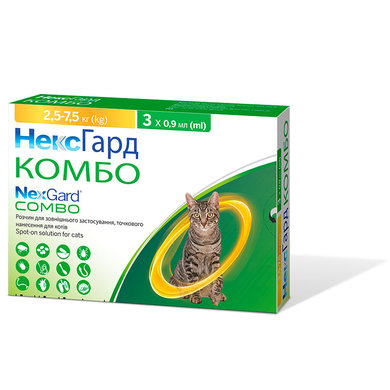
NexGard Combo is intended for the control and prevention of infection with fleas, mites (including ear mites) and helminths in cats. The drug is convenient because it simultaneously affects 12! types of feline parasites. It is recommended to be used when the animal suffers from external and internal parasites at the same time or there is a reasonable suspicion of such a problem.
The drug NexGard Combo destroys ticks and protects against re-infection from a month to 5 weeks (depending on the species), and kills fleas so quickly that they do not have time to lay eggs. NexGard Combo is just as cruel to worms. An amazing drug of the new generation will cleanse the cat's body of most types of parasites in just one dose! The drug is also effective in the treatment of ringworm.
The three active substances in the composition of the drug effectively fight not only with adult individuals of parasites, but also with their larvae. Cats must be treated for parasites, otherwise they reproduce very quickly and in critical quantities can cause irreparable damage to the pet's health. NexGard Combo can be used not only for adult cats, but also for kittens in the period of active growth: the use is allowed for animals 8 weeks from birth and weighing from 0.8 kg.
NexGard Combo is used to treat tapeworms, gastrointestinal helminths, it is also effective in the treatment of infections caused by pulmonary helminths, and is used to prevent heartworm disease.
Infection of animals simultaneously with different types of parasites – a big problem and NexGard Combo is a reliable helper in the fight against it.
Advantages and features:
- broad-spectrum antiparasitic drug: effectively fights endo- and ectoparasites;
- recommended for use when affected by several types of parasites;
- can be used for kittens over 8 weeks old;
- is a preventive measure against heartworm disease;
- the drug is available in 2 dosages;
- simple and convenient form of application;
- a drug safe for animals and effective against parasites.
Each dose of the applicator contains:
- Active substances: esafoxolaner, eprinomectin, praziquantel
- NexGard Combo dosage unit volume (ml):
- Esafoxolaner (mg) 3.60
- Eprinomectin (mg) 1.20
- Praziquantel (mg) 24.90
-
Excipients:
- Butylhydroxytoluene (E321) 1 mg/ml.
External use only.
Clear solution from colorless to light yellow or light brown.
Indications:
- For cats infected or at risk of simultaneous infection with cestodes, nematodes and ectoparasites.
- The veterinary medicinal product is indicated only for simultaneous effects on all three groups.
-
Ectoparasites:
- Treatment of flea infestations (Ctenocephalides felis). One treatment provides immediate and sustained flea killing activity for one month.
- The product may be part of a treatment strategy for allergic dermatitis caused by fleas (DAP).
- Treatment of tick infestation. One treatment provides immediate and sustained tick control against Ixodes scapularis for one month and against Ixodes ricinus for five weeks.
- Treatment of lichen infestation (Otodectes cynotis).
-
Tape worms:
- Treatment of flatworms (Dipylidium caninum, Taenia taeniaeformis, Echinococcus multilocularis, Joyeuxiella pasqualei and Joyeuxiella fuhrmanni).
-
Nematodes:
- Prophylaxis of cardiac heartworm disease (Dirofilaria immitis) within a month.
- Treatment of gastrointestinal nematode infections (larvae L3, L4 and adults of Toxocara cati, larvae L4 and adults of Ancyclostoma tubaeforme and Ancyclostoma ceylanicum and adult forms of Toxascaris leonina and Ancyclostoma braziliense).
- Treatment of feline lungworm infections (L4 larvae and adults of Troglostrongylus brevior).
- Treatment of bladder infections (Capillaria plica).
Contraindications:
Do not use in cases of hypersensitivity to active substances or any of the excipients.
Side effects
In clinical studies, hypersalivation, diarrhea, transient skin reactions at the application site (local alopecia, pruritus), anorexia, lethargy, and vomiting were rarely observed shortly after administration. Most of the reactions are mild, short-lived and self-resolving.
The frequency of adverse reactions is determined using the following convention:
- Very common (more than 1 in 10 treated animals have adverse reactions)
- Frequent (more than 1 but less than 10 animals per 100 treated animals)
- Uncommon (more than 1 but less than 10 animals per 1000 treated animals)
- Rare (more than 1 but less than 10 animals per 10,000 animals treated)
- Very rare (less than 1 animal per 10,000 animals treated, including isolated reports).
If you notice any side effects, even those not already listed in this leaflet, or if you think that the medicine has not worked, tell your veterinarian .
Target species: cats
How to use:
- For local application to the skin (point injection).
- Minimum recommended doses are 1.44 mg esafoxolaner, 0.48 mg eprinomectin and 10 mg praziquantel per kg of body weight.
Recommendations for use:
- Use an applicator of the appropriate volume for the cat's weight (0.3 or 0.9 ml).
- Use scissors to cut the package along the dotted line.
- Take the applicator out of the package and hold it with the tip up.
- Slowly pull the piston back, turn and remove the cap.
- Prepare the place on the animal's nape (a place that is hard to reach for licking the drug) for applying the drug by spreading the cat's fur and exposing the skin area.
- Place the tip of the applicator on the skin and apply the entire contents directly to the skin in one place.
- The product must be applied to dry skin in a place where the cat cannot lick it off. In long-haired breeds, special care must be taken to apply the product directly to the skin and not the wool to ensure optimal effectiveness.
Scheme of treatment:
- For the treatment of flea and/or tick and/or ringworm infestations and concomitant treatment of gastrointestinal and/or pulmonary and/or urinary nematodes and cestodes, one dose of the drug should be used. The need and frequency of treatment should be in accordance with the recommendations of the veterinarian and take into account the local epidemiological situation and the lifestyle of the animal (for example, if it has access to the street).
- Endemic areas without cardiovascular heartworm disease: cats that are not at constant risk of heartworm infection should be treated according to a program recommended by a veterinarian adapted to of each individual situation of re-infection/infection with parasites. Otherwise, a product with a shorter spectrum of action should be used, which ensures the correct treatment of the relevant parasites.
- Cardiovascular heartworm endemic areas: cats living in heartworm endemic areas may be treated at monthly intervals to ensure adequate prevention of heartworm treatment of possible re-infection with cestodes. Otherwise, it is necessary to use a product with a shorter spectrum of action to continue the treatment. Prevention of cardiovascular helminths, heartworms by killing Dirofilaria immitis larvae should be started within 1 month after the first contact with mosquitoes and foodchew up to 1 month after the last contact with mosquitoes.
- Ear tick infestation: in case of ear infestation, ask for a new veterinary examination 4 weeks after treatment to decide if additional treatment with a lower spectrum medicine is needed actions.
Special precautions for storage:
- Keep out of the reach of children.
- Keep the unused applicator in the original packaging to protect from light.
- Used material should be disposed of immediately as waste.
- Do not use this veterinary product after the expiry date stated on the package.
Special warnings:
Special precautions after use:
- Avoid shampooing the animal for the next 2 days after administration, as the effectiveness of the product in this case has not been tested.
- Ticks and fleas must start feeding on the cat to be exposed to esafoxolaner, so the risk of arthropod transmission cannot be ruled out.
- Cats living in areas endemic for cardiovascular helminths, or those who have traveled to such areas, may be infected with adult heartworms. Although the drug can be safely administered to cats infected with adult heartworms, the therapeutic effect against adult heartworms Dirofilaria immitis has not been established. Therefore, it is recommended that all cats 6 months of age and older living in heartworm-endemic areas be tested for adult heartworm infection prior to treatment with a heartworm preventative.
- Flat helminth infections can recur if intermediate hosts such as fleas, mice, etc. are not controlled.
- Parasite resistance to a certain class of antiparasitic drugs can develop as a result of repeated use of a compound of this class over a long period of time. Therefore, epidemiological information on the current susceptibility of target species should be taken into account to limit the possibility of future resistance selection.
- To reduce repeated infections with the appearance of new fleas, it is recommended to treat all cats in the house. Any other species of animals that live in the same house should be treated with the means intended for them.
- Fleas at any stage of their development can infest the cat's litter box, its usual resting places, such as carpets and upholstered furniture. In case of a large infestation and before applying control measures, these areas should be treated with an appropriate agent and vacuumed regularly.
Special precautions for use in animals:
- For point application only. Do not enter by injection, do not enter orally or by other means of administration. Avoid contact with the cat's eyes. In case of accidental contact with the eyes, immediately rinse the area around the eyes with clean water. If eye irritation persists, seek veterinary advice.
- It is very important that the application of the veterinary medicinal product is carried out on the skin in an area where the cat cannot lick the product on the back of the head between the shoulder blades. Make sure that the animals do not lick each other until the treated area is no longer visible. It has been noted that oral administration of the veterinary medicinal product causes hypersalivation in cats.
- The safety of the veterinary medicinal product has not been tested in kittens under 8 weeks of age. The product is not intended for cats weighing less than 0.8 kg and/or less than 8 weeks of age.
- The veterinary medicinal product should be used exclusively against confirmed mixed infections or when cats are at significant risk of such mixed infections with ectoparasites and nematodes (including for the prevention of cardiovascular heartworm disease) and when simultaneously treatment against cestodes is indicated. If there is no risk of co-infestation, an antiparasitic agent with a shorter spectrum of action should be used as the first line of treatment.
- The reason for prescribing and the frequency of use of this product should take into account the individual needs of the cat based on clinical assessment, the animal's lifestyle and the epidemiological situation (including zoonotic risk if applicable) so that a decision can be made about application. exclusively in the villagesituations of infection or risk of combined infection.
- The veterinary medicine cannot be used on other cats without prior consultation with a veterinarian.
- Repeated courses of treatment should be limited to specific individual situations (see recommendations for the use of treatment in the "Recommendations for correct use") with a minimum interval between courses of treatment of 4 weeks. Safety has not been evaluated for more than 6 months, so a maximum of 6 consecutive months of treatment within a 12-month period is recommended.
- Echinococcosis poses a danger to humans and is one of the diseases controlled by the World Organization for Animal Health. With echinococcosis, it is necessary to observe special rules of treatment and observation and protection of persons. You should consult with parasitological experts or institutes.
Special precautions to be observed by persons administering veterinary medicinal products to animals:
- Do not smoke, drink or eat while working with the product.
- Wash hands immediately after use.
- Used applicators should be disposed of immediately and kept out of the sight or reach of children.
- Avoid contact of fingers with the contents of the applicator. If this happens, wash with soap and water. This veterinary medicinal product may cause eye irritation, which in exceptional cases may be severe. In case of accidental contact with the eyes, rinse immediately and thoroughly with water. Remove contact lenses, if worn, for the first 5 minutes and continue rinsing. Seek medical advice and show the leaflet or product label to the doctor.
- Before touching the application area, make sure that the area where the product was applied is no longer visible. Children should not play with treated animals until the application site is no longer visible, and it is recommended that recently treated animals do not sleep with their owners, especially children. It is recommended to process animals in the evening to reduce contact with humans after processing.
- People with known hypersensitivity to esafoxolaner, eprinomectin or praziquantel or to any of the excipients should not use this veterinary medicinal product.
- Since fetotoxic and teratogenic effects have been described in laboratory animals after significant daily exposure to glycerol formal, pregnant women should wear gloves during administration to avoid direct contact with the product.
Pregnancy and lactation:
The safety of the veterinary medicinal product during pregnancy and lactation has not been established. Since fetotoxic and teratogenic effects have been described in laboratory animals following significant daily exposure to glycerol formal, it should only be used in accordance with a risk/use assessment by a veterinarian.
Overdose:
- Safety in use was evaluated in healthy kittens 8 weeks of age and older, administered 5 times the maximum recommended dose and up to 6 times at 4-week intervals. At a dose 3 times higher than the maximum recommended dose, no adverse reactions were observed. At a dose 5 times the maximum recommended dose, one severe neurological adverse reaction (ataxia, disorientation, apathy, tremor, hypothermia, and pupil dilation) was observed after the third treatment, which was reversible after washing the affected area.
- In some animals, when the maximum 5 times the recommended dose was administered, dark red subcutaneous areas were observed at the injection site.
Registration certificate: Boehringer Ingelheim Vetmedica GmbH 55216 Ingelheim/Rhein Germany
Owner of registration certificate: Boehringer Ingelheim International GmbH, Germany
Location of production facilities: France, Brazil