HOME FOOD Blog: Avitaminosis in Cats – How to Prevent, Diagnosis and Treatment
Avitaminosis in Cats – How to Prevent, Diagnosis and Treatment
Avitaminosis in cats — a common but often underestimated problem that can significantly affect your pet’s health, activity, and immunity. A deficiency of vitamins and minerals does not always manifest brightly, and its consequences can accumulate gradually, causing weakness, coat problems, digestive issues, and metabolic disorders.
In this blog, we will look at how to prevent avitaminosis, what to pay attention to during diagnosis, and which treatment approaches are used in veterinary practice so that your cat stays healthy, active, and cheerful.
Causes of avitaminosis in cats and differences from hypovitaminosis
Avitaminosis — is the complete absence of one or more vitamins in the body, leading to pronounced metabolic disorders and organ dysfunctions. It differs from hypovitaminosis, in which there is a partial deficiency, the symptoms of which may be unnoticeable or appear only gradually.
Why does avitaminosis occur in cats
Main causes:
- Incorrect or monotonous feeding, especially a diet consisting solely of low-quality dry food or homemade food without a balanced composition.
- Chronic gastrointestinal diseases that impair vitamin absorption.
- Increased body needs during growth, pregnancy, lactation, illness, or stress.
- Long-term antibiotic therapy or treatment with other medications that affect the absorption of micronutrients.
Which vitamins are most commonly lacking
- Vitamin A — important for vision, immunity, and skin health.
- Vitamin D — regulates calcium metabolism, important for bones.
- Vitamin E — an antioxidant, supports muscles and immunity.
- B-group vitamins (B1, B2, B6, B12) — necessary for the nervous system, metabolism, and blood formation.
- Vitamin K — needed for normal blood clotting.
What must be in the diet for complete avitaminosis to occur
Complete avitaminosis in cats develops very rarely and, as a rule, only when:
- long-term feeding of homemade food without including meat, offal, fish, and micronutrients,
- using low-quality dry food without vitamin premixes,
- monodiets where sources of a particular vitamin are completely absent (for example, no source of vitamin A or D at all).
How common is this phenomenon
Modern balanced ready-made feeds and controlled homemade diets make complete avitaminosis in cats quite a rare phenomenon; it most often occurs in kittens on one-sided feeding or in animals with chronic digestive diseases. Veterinarians more often diagnose hypovitaminosis, when the deficiency is partial and less pronounced, but also requires correction.

Dry food HOME FOOD Hairball control for sterilised/neutered adult cats Turkey & Berries For sterilised/neutered, 1.6 kg
Buy
Dry food HOME FOOD for active adult cats Chicken & Shrimp For active, 1.6 kg
Buy
Dry food HOME FOOD for sterilised/neutered adult cats Rabbit & Cranberry For sterilised/neutered, 1.6 kg
Buy
Dry food HOME FOOD for adult British and Scottish breed cats Turkey & Duck For British and Scottish breeds. Suitable for large breeds, 400 g
Buy
Dry food HOME FOOD Healthy skin and shiny coat for adult cats Turkey & Salmon Healthy skin and shiny coat, 1.6 kg
Buy
Dry food HOME FOOD for sterilised/neutered adult cats with sensitive digestion Lamb & Salmon With sensitive digestion. For sterilised/neutered, 1.6 kg
Buy
Diagnosis of avitaminosis in cats
Detecting avitaminosis in cats requires a comprehensive approach: a combination of visual assessment, physiological condition, and laboratory tests. It is difficult to make an accurate diagnosis on your own, so it is important to contact a veterinarian at the first suspicion of vitamin deficiency.
1. External signs (visual diagnosis in the clinic)
The veterinarian evaluates the condition of the coat, skin, eyes, teeth, and the animal’s overall behavior. Typical manifestations of avitaminosis:
- Dull, brittle coat with hair loss or bald patches — often with a deficiency of vitamins A and E.
- Dryness, flaking of the skin, formation of cracks — lack of B vitamins and A.
- Gum problems, bleeding — signs of vitamin K deficiency.
- Weakness, lethargy, apathy — non-specific signs indicating metabolic disorders.
These signs help suspect avitaminosis, but do not always allow to accurately determine which vitamins are lacking.
2. Physiological dysfunctions
Vitamin deficiency affects the functioning of organs and systems:
- Disorders of the gastrointestinal tract — poor absorption of nutrients, diarrhea or constipation.
- Bone and joint problems — lack of vitamin D.
- Reduced immune protection — frequent infections with deficiency of vitamins A, E, B.
- Blood clotting problems — with vitamin K deficiency.
Observing physiological manifestations helps determine the direction of laboratory tests.
3. Laboratory diagnosis
Laboratory confirmation of avitaminosis includes:
- Determination of vitamin levels in the blood (A, D, E, K, B12, etc.).
- Accuracy: high for both water-soluble and fat-soluble vitamins if the sample is properly collected and stored.
- Availability: average clinics can only perform basic tests; a full profile often requires specialized laboratories.
- Reality: accurate analysis is more expensive, but gives confidence in diet correction and therapy.
- Study of metabolic markers — for example, calcium and phosphorus in vitamin D deficiency, coagulation profile in vitamin K.
- Condition of blood and organs — a complete blood count helps assess secondary manifestations of avitaminosis: anemia, increased vascular permeability, inflammatory processes.
Diagnosis summary
- Visual and physiological signs allow suspecting avitaminosis and choosing the direction of examination.
- Laboratory tests provide accurate identification of the deficiency of specific vitamins, determine the severity of the condition and allow monitoring the effectiveness of treatment.
A comprehensive approach guarantees that avitaminosis will be detected at early stages, and diet correction and therapy will bring maximum effect for the cat’s health.

Treatment of avitaminosis in cats
Treatment of avitaminosis is based on compensating for vitamin deficiency, and it remains relevant even in cases where specific laboratory diagnosis has not been carried out. Even with a clinical diagnosis of “avitaminosis,” the main approach is additional administration of vitamins and minerals to restore normal metabolism and support body functions.
Forms and approaches to treatment
1. Complex vitamins and functional supplements
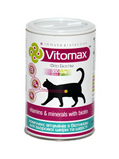
- Most often, complex preparations containing vitamins, minerals, and amino acids are used (2,3,4)
- This is especially effective for alimentary avitaminosis, when the deficiency is caused by improper nutrition or a one-sided diet.

Synbiotic for digestion and immunity support HePawSyn HOME FOOD Expert, 250 g
Buy
Vitamin complex Canina Cat-Vitamin Tabs for cats, 100 tabs
Buy
2. Specific vitamins
- When a deficiency of a specific vitamin is confirmed (for example, A, D or B12), targeted preparations are used, often in the form of oils, capsules, suspensions or injections

Salmon oil for healthy skin and shiny coat for dogs and cats, 100 ml
Buy
Phytomin for cats HOME FOOD “Krill” oil for recovery after moulting, 100 ml
Buy
Phytomin for cats HOME FOOD “Omega Balance” oil Omega-3, -6, -9 balance, 100 ml
Buy
Phytomin for cats HOME FOOD “Sesame” oil for normalisation of gastrointestinal tract, 100 ml
Buy
3. Administration in case of absorption impairment
- If avitaminosis is caused by impaired absorption in the gastrointestinal tract, standard oral forms may be insufficient.
- In such cases, intravenous (IV) or intramuscular (IM) administration of vitamins is considered to ensure effective delivery to the body.
Key principle of treatment
Comprehensive and balanced administration of vitamins and minerals helps quickly restore metabolism, support immunity, improve the condition of skin, coat, and overall activity of the cat. The selection of specific preparations and administration schemes is always carried out by a veterinarian, taking into account the age, weight, health condition, and dietary characteristics of the animal.
Prevention of avitaminosis in cats
In the modern world, complete avitaminosis in cats is very rare — mostly it is typical for stray animals that do not have access to balanced nutrition. However, prevention remains extremely important, because vitamin deficiency suppresses immunity, increases the risk of infectious diseases and even contributes to the transmission of zoonoses.
Prevention for domestic cats
- Use of super-premium food according to the physiological age of the animal.
- Ensuring a balanced diet with all the necessary vitamins, minerals, and amino acids.
- Regular preventive check-ups with a veterinarian, especially for kittens and senior cats.
Prevention for street cats and stray animals
- Be a conscious and responsible person, develop empathy and love for living beings.
- Feed strays with complete balanced food that contains all the necessary nutrients.
- Create temporary homes or winter shelters, provide animals with a safe environment.
- Help find permanent families for stray cats.
- Never behave cruelly — it is not only humane, but also prevents population degradation and reduces the risk of spreading zoonoses among people.

Portion of food for a shelter cat
Buy
Proper care and attention to nutrition, both for domestic and street cats, help maintain a healthy population, support immunity and prevent the development of avitaminosis, making the life of animals and people safer and more harmonious.