The Balinese cat is a breed for those who dream not just of a beautiful animal at home, but of a true companion. Graceful, emotional, very intelligent, and devoted, it easily becomes the center of attention in the family.
It is often described as a Siamese cat in a softer, silkier, and even more people-oriented form. This combination of external grace and strong attachment to humans is what makes the Balinese so special.
In this article, we will look at where the breed comes from, what it looks like, what temperament it has, how to care for such a cat properly, what to feed it, and who it suits best.
Brief breed profile
| Origin | USA, 1940s–1950s; a descendant of the Siamese cat with a longer coat |
| Other name | Balinese |
| Breed type | Semi-longhaired, selectively bred, related to the Siamese breed |
| Size and weight | Medium size, approximately 2.5–5 kg |
| Life expectancy | On average, 13–18 years |
| Color | Colorpoint: a light body with darker ears, muzzle, paws, and tail; seal, blue, chocolate, and lilac points are possible |
| Coat type | Fine, silky, medium-length, without a dense undercoat |
| Temperament | Affectionate, emotional, very sociable, intelligent, vocal, and devoted |
| Care | Moderate: regular brushing, eye, ear, dental, and claw hygiene, plus warmth and activity control |
| Best suited for | People who are ready to communicate a lot with their pet and want close contact with a companion cat |
History of origin
Despite its exotic name, the Balinese cat does not come from Indonesia, but from the United States. In the 1920s–1930s, Siamese cats sometimes produced kittens with semi-long coats, and at first this trait was considered undesirable.
Such kittens were not admitted to breeding programs, were given away for free, or were sterilized in an effort to preserve the familiar Siamese type. But the long-hair gene did not disappear, and over time breeders began to see it not as a defect, but as a distinct beautiful feature.
In the 1950s, Helen Smith and Marion Dorsey began working purposefully with these cats, achieving the stable appearance of semi-longhaired Siamese cats. In 1970, the new breed received official recognition, and the name “Balinese” was chosen because of an association with the grace of dancers from the island of Bali.
The breed reached Europe later, and today Balinese cats are recognized by major feline associations. They remain rare, but highly valued by admirers of an elegant type and a strong temperament.
- The Balinese cat emerged as a longhaired variant of the Siamese that eventually became a separate breed.
- Its name is connected not with its origin, but with the impression of grace and lightness in movement.
- Today, it is a rare breed especially valued for its combination of beauty, intelligence, and a strong bond with people.
Appearance
At first glance, the Balinese cat truly resembles the Siamese, but its silhouette looks softer and smoother thanks to its semi-long coat. It is a very slender, elegant, and flexible cat with visible musculature, but without heaviness.
The Balinese has an elongated body with well-developed musculature. The head is wedge-shaped, the profile is straight, and the eyes are almond-shaped, slightly slanted, and deep blue. The ears are large with a broad base, and the legs are long and fine, with the hind legs slightly longer than the front ones.
The breed has a thin, very fluffy tail, while the coat is smooth, silky, without a dense undercoat, and noticeably lengthens toward the tail. This is why the overall silhouette appears even more refined and “dancing.”
The colorpoint pattern is the breed’s hallmark. A light body with darker ears, muzzle, paws, and tail is caused by temperature-dependent pigmentation: cooler areas of the body become darker. The breed standard does not allow white spots, an undercoat, an incorrect bite, eyes of any color other than blue, tail defects, or polydactyly.
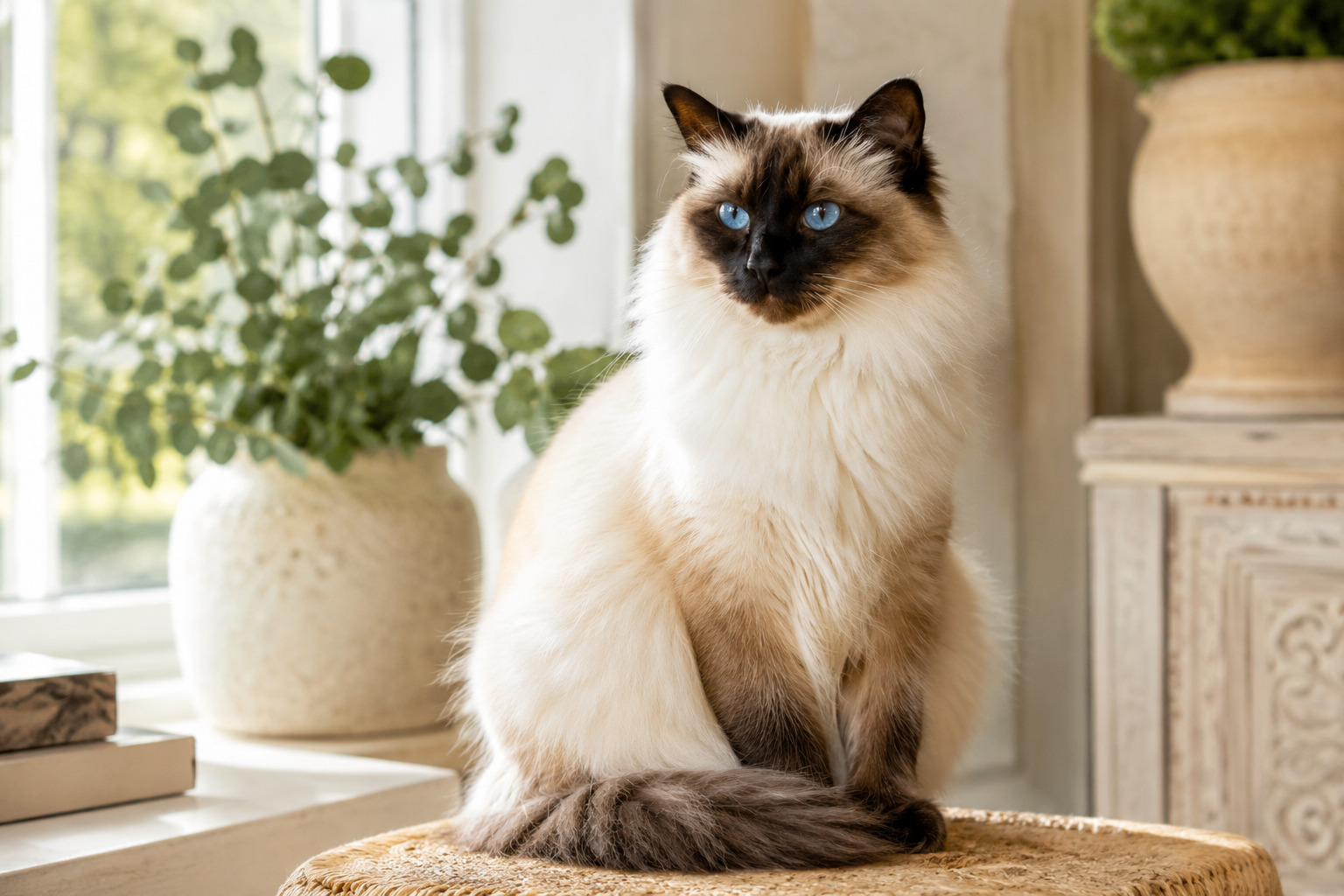

The Balinese is not just a beautiful cat with a longer coat, but a breed with a highly recognizable silhouette combining Siamese elegance, silky lightness, and vivid emotionality
Temperament
The Balinese cat is a true companion cat. It is highly people-oriented, emotional, sociable, and often so involved in family life that its level of attachment seems almost dog-like. If you need a cat that will greet you after work, follow you with its gaze, sleep nearby, and regularly “talk” to you, the Balinese is an ideal fit.
The breed is known for high intelligence: these cats learn easily, remember household rules well, understand intonation, and often sense their owner’s mood very subtly. At the same time, they are quite emotional and do not like rough handling.
Balinese cats are active and love climbing structures, movement, puzzle toys, and taking part in any household event. They usually get along well with children and can live with other cats and dogs if socialization is handled properly.
At the same time, this breed does not tolerate long periods of loneliness well. If no one is home most of the time, a Balinese may become bored, sad, and even show behavioral difficulties. In such a situation, it needs company: another animal, plenty of interactive activities, or more meaningful contact with people.
- The Balinese cat is deeply attached to people and loves being nearby.
- It is intelligent, talkative, emotional, and learns household rules well.
- The breed suits those who are ready to invest in daily interaction rather than looking for a highly independent cat.


HOME FOOD For active — dry food for active adult cats, chicken and shrimp
Buy
HOME FOOD — complete food for adult cats with beef and salmon in jelly
Buy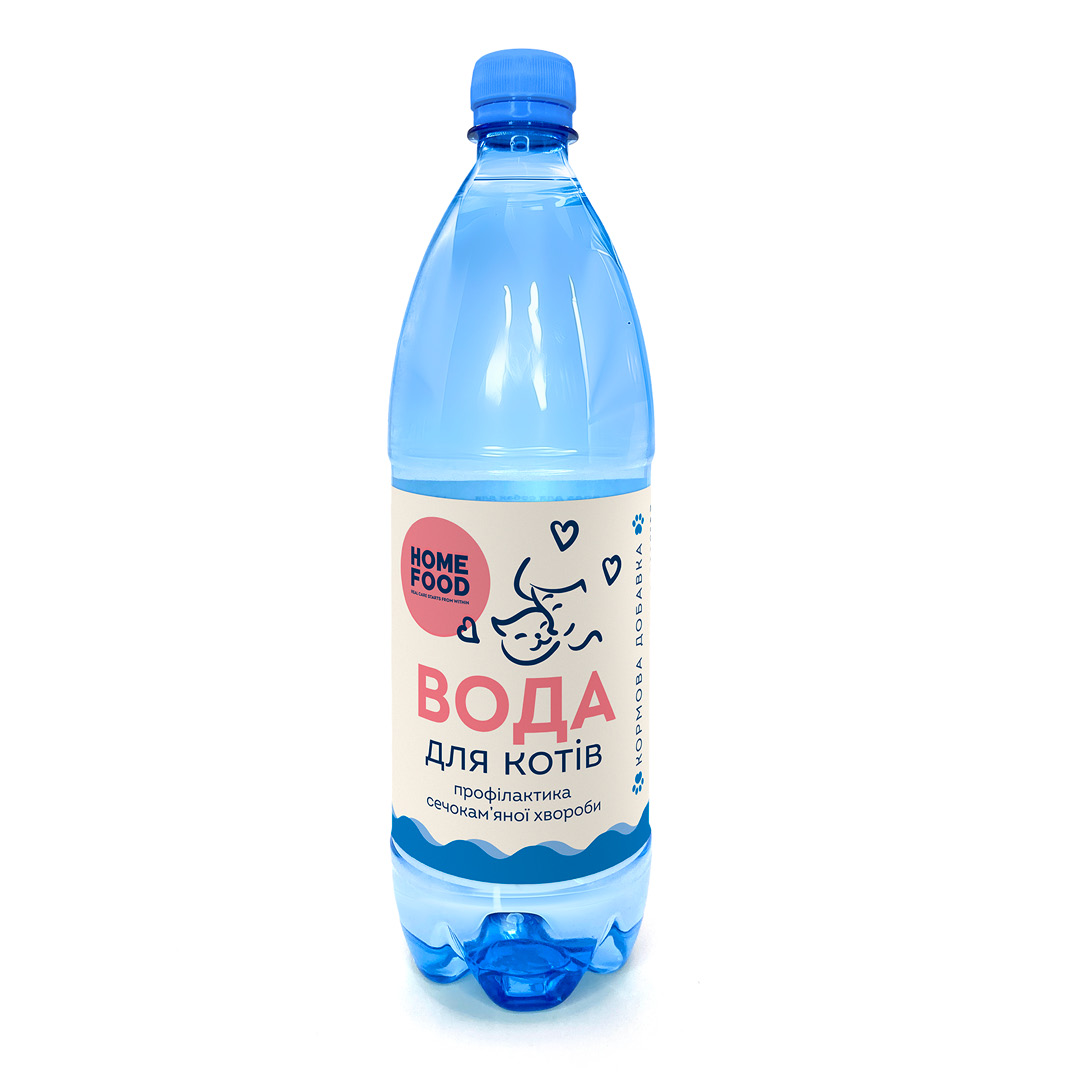
HOME FOOD — drinking water for cats for urinary stone prevention
Buy
HOME FOOD Hairball control — food for hairball control, turkey and berries
Buy
Care
One reason for the Balinese cat’s popularity is its relative ease of care. Despite its semi-long coat, this breed does not have a dense undercoat, is not prone to severe matting, and usually does not create excessive household difficulties.
The source notes that the coat should be brushed 1–2 times a week, and more often during shedding, even daily if needed. This helps maintain a neat appearance and prevent tangling.
The eyes are wiped with a cotton pad and boiled water when needed, the ears are cleaned with a special lotion if dirty, and the claws are trimmed every 2–3 weeks. The teeth should preferably be brushed at least twice a week with a special cat toothpaste, as the breed has some tendency toward dental issues.
Another important trait is sensitivity to cold. Balinese cats love a comfortable warm environment, dislike drafts, and feel better where the home has a stable, cozy temperature. They also truly need games and movement: this is not only physical exercise, but also a way to support emotional well-being.
Regular care for a Balinese includes:
- Brushing 1–2 times a week, and more often during shedding.
- Cleaning the eyes as needed and monitoring discharge.
- Cleaning the ears with a special product when dirty.
- Trimming claws every 2–3 weeks.
- Brushing teeth at least twice a week.
- Maintaining comfortable warmth and daily play activity.

Foldable brush — for longhaired cats
Buy
Easy Brush ProbioDay — anti-mat conditioning spray for easy brushing
Buy
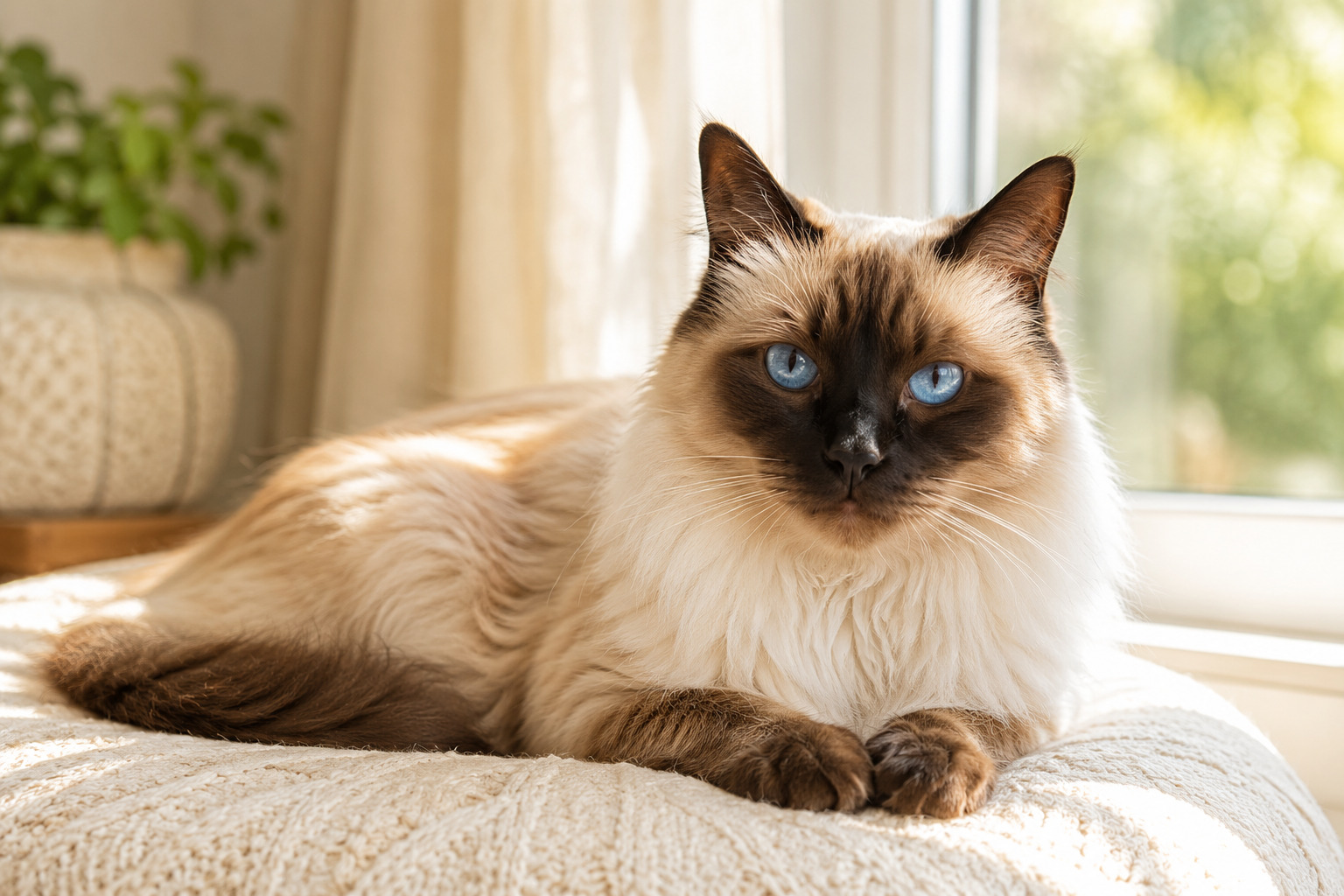
The Balinese cat does not require complicated grooming, but greatly values consistency, gentle careful care, warmth at home, and daily attention to communication and play
Health
Balinese cats can generally live long and active lives, but they have certain health specifics due to their close relationship with Siamese cats. Along with strong traits, they inherited some potential weak points, so preventive care is genuinely important for this breed.
The source mentions possible problems with vision, teeth, the heart, metabolism, and the respiratory system. These include hepatic amyloidosis, dilated cardiomyopathy, diabetes mellitus, aortic stenosis, bronchial asthma, megaesophagus, progressive retinal atrophy, gingivitis, hyperesthesia, and nystagmus.
This does not mean that every Balinese cat will necessarily face these conditions. But when choosing a kitten, it is advisable to pay attention to the animal’s origin, the cattery’s reputation, the availability of genetic tests, and the owner’s readiness to visit a veterinarian regularly.
The text also mentions an interesting bonus: Balinese cats may have lower levels of the allergenic proteins Fel d 1 and Fel d 2 than many other cats. They are not fully hypoallergenic, but they may sometimes be better suited to people with mild allergies.
For health prevention, the following are especially important:
- Regular preventive veterinary checkups at least once a year.
- Monitoring the condition of the teeth, eyes, and respiratory system.
- Timely vaccination and routine parasite prevention.
- Careful selection of a kitten from a trusted source and, when possible, genetic testing.
Nutrition
Balinese cats are not considered picky eaters, but this does not mean they can be fed a random diet. To support health, activity, coat condition, and vision, they need balanced nutrition with enough protein and taurine.
The source describes two main feeding options. The first is a natural diet that must be formulated together with a veterinary nutritionist so the cat receives meat, organ meats, additional trace elements, and vitamins in the right proportions. The second is premium or super-premium ready-made food selected according to age, sterilization status, and health specifics.
It is also important to remember constant access to fresh water, especially if the diet includes dry food. This helps reduce the risk of dehydration and supports normal urinary system function.

Virbac Enzymatic — oral hygiene kit for dogs and cats
Buy
Advocate — antiparasitic drops for cats and ferrets up to 4 kg
Buy
Trixie — large nail clippers for dogs and cats, 13 cm
Buy
Tropiclean Spa — facial cleanser for tear stains, 236 ml
Buy
Pros and cons of the breed
The Balinese cat is a bright, intelligent breed that becomes very close to people, but this closeness does not suit everyone. Before choosing one, it is important to see not only its beauty, but also its temperament and household needs.
Pros
- High intelligence and good trainability.
- A very strong emotional bond with the owner.
- Aesthetic, refined appearance and silky coat.
- Relatively easy care despite the semi-long coat.
- Lower levels of allergenic proteins in some representatives of the breed.
- Good compatibility with children and other animals when properly socialized.
Cons
- Does not tolerate long loneliness well and may suffer without attention.
- Can be quite vocal and “talkative.”
- Sensitive to cold and loves stable home comfort.
- Has certain breed-related health risks due to its relationship with Siamese cats.
- Not suitable for those who want a highly independent and quiet cat.
In the end, the Balinese is an excellent choice for those looking for an emotionally involved, gentle, and very intelligent pet, and who are ready to return that closeness.
Who the Balinese cat is best suited for
This breed feels best in a home where the cat is not left as a “decoration,” but is a true family member. The Balinese cat suits people who want lively contact, communicate a lot with their pet, and are ready for games, affection, and daily interaction.
It will suit families with children, people who work from home or spend a lot of time near their pet, and those who value not only beauty but also intelligence and character. If you prefer a quiet and highly independent cat, the Balinese may seem too involved in your life.
This is not a breed for distance, but for closeness. That is why it is especially valuable for those who want not simply to keep an animal, but to live alongside a truly devoted friend.
Conclusion
The Balinese cat is a combination of elegance, emotionality, intelligence, and deep attachment to people. It is beautiful, but its main strength is not even its appearance, but how closely it can become part of its family’s everyday life.
If you are ready to share attention, warmth, and time with your pet, the Balinese can become one of the most devoted and gentle cats imaginable. This is a breed that does not simply live nearby, but truly fills the home with communication, soft purring, and a sense of living presence.