


📌 HOME FOOD Blog: Fleas in Cats: What to Do, Treatment, How to Get Rid of Them
Fleas in Cats: What to Do, Treatment, How to Get Rid of Them
Fleas are small but extremely persistent creatures that can cause discomfort even to the most well-groomed cat. In the modern world, where cats live not only outdoors but also in cozy apartments, they are still exposed to contact with the external environment: balcony walks, visits to veterinary clinics, or proximity to other animals. In nature, cats, like their wild ancestors, lead an active lifestyle, and fleas reproduce lightning-fast, taking advantage of any opportunity for feeding and reproduction. That’s why knowing how to recognize fleas, protect your pet, and effectively treat parasites is more important today than ever — it helps preserve the cat’s health, the owner’s peace of mind, and harmonious coexistence with our little furry friend.
How fleas are structured and their life cycle
Fleas are tiny, wingless parasites specialized in feeding on the blood of warm-blooded animals, particularly cats. They have a body flattened from the sides, allowing easy movement through fur, long hind legs for jumping, and sharp mouthparts for piercing skin and sucking blood.
Flea life cycle
Fleas undergo complete metamorphosis:
- Egg — small, visible in the fur. The female lays them after her first blood meal. Eggs do not stay on the cat’s body but fall into fur, bedding, carpets, or soil.
- Larva — legless, small worm-like creature feeding on organic debris (skin particles, adult flea feces). Larvae avoid light and hide in cracks, carpets, soil, or under trees.
- Pupa — the larva wraps itself in a cocoon and enters a dormant stage. The pupa can remain viable for weeks or even months, waiting for signals (heat, vibrations, carbon dioxide) indicating a host’s presence.
- Adult flea — emerges when a host animal appears. Adult fleas immediately begin feeding on blood and are ready to reproduce within a few days.
Where fleas live
- Fleas can live not only on the cat’s body but also in the surrounding environment: carpets, bedding, floor cracks, outdoor soil where the cat goes.
- They do not move well on the ground, but larvae successfully develop in bedding, leaves, or soil — there they hide from light and drying out.
How fleas bite
- Adult fleas use sharp mouthparts to pierce the cat’s skin and suck blood.
- A bite can cause itching, redness, and an allergic reaction in the animal, especially in sensitive cats.
- After feeding, the female lays eggs, allowing a new generation to appear quickly if the environment is favorable.
Why fleas are dangerous: diseases and consequences
Fleas are not only a source of itching and discomfort for cats but also a potential threat to the animal’s health and even humans. Their bites can cause allergic reactions, transmit diseases and parasites, and massive infestation can lead to serious problems.
1. Flea allergy dermatitis
- In some cats, even a single flea bite can trigger severe itching, redness, and skin flaking.
- This condition is called flea allergy dermatitis (FAD).
- Itching forces the cat to scratch constantly, which can lead to scratches, infections, and hair loss.
2. General health decline
- Massive flea infestation in kittens or weakened cats can cause anemia, as fleas suck blood.
- Constant stress from bites and itching can lower immunity, making the animal more vulnerable to other diseases.
3. Vectors of parasites and diseases
Fleas can carry parasites and pathogens that can infect cats and humans:
- Worms (cysticerci and tapeworms) — larvae of some worms develop inside fleas. If a cat accidentally swallows a flea while grooming, it can become infected.
- Bacteria causing bartonellosis (cat scratch fever) — through flea bites, the bacterium can be transmitted to the cat and even to humans.
- Blood parasites — in some regions, fleas carry hemoparasites that affect the blood and overall condition of the animal.
- Potential risk to humans — flea bites in humans usually cause itching and redness, and sometimes can be a source of bacteria or allergy.
4. Transmission scheme
- A flea bites the cat, feeding on blood.
- During the bite or upon the flea’s death, pathogens or parasite eggs are released.
- The animal becomes infected through bites or accidental ingestion of a flea.
- Massive infestation or allergic reaction can lead to serious complications.
How to easily diagnose fleas
You can check for fleas on a cat even at home using a simple method. One of the most convenient ways is the paper-and-water test:
- Place a white sheet of paper or napkin under the cat while it is moving actively or being brushed.
- Comb the fur with a special flea comb — tiny black or brown specks falling onto the paper are most often flea droppings.
- Drip a little water onto the specks: if they dissolve and form reddish or rusty streaks, this confirms the presence of blood and, therefore, fleas.
This method is simple, safe, and allows you to quickly confirm that the cat needs antiparasitic treatment.

Evolution of antiparasitic products against fleas
Combating fleas has always been a challenging task due to their rapid life cycle and ability to hide in the environment. Over the past decades, antiparasitic products have evolved, becoming more effective, safer, and more convenient for cat owners.
1. Early methods
In the past, powders, dusting powders, soaps, and bathing were most commonly used. They could partially kill adult fleas on the cat’s fur but had no effect on eggs and larvae in the environment. As a result, fleas often reappeared after a few days or weeks.
2. First chemical insecticides
With the development of chemistry, pesticides for animals such as permethrin and malathion appeared. They were more effective against adult fleas and partially against larvae, but often had high toxicity to cats and humans and could accumulate in the environment.
3. Modern systemic and topical products
Today, products are used that target the entire flea life cycle:
- Drops and spot-on treatments — spread over the skin and fur, killing adult fleas and preventing egg development.
Recommended Products

NexGard Combo — spot-on antiparasitic drops against fleas, ticks, and worms for cats (up to 2.5 kg), 1 applicator
Buy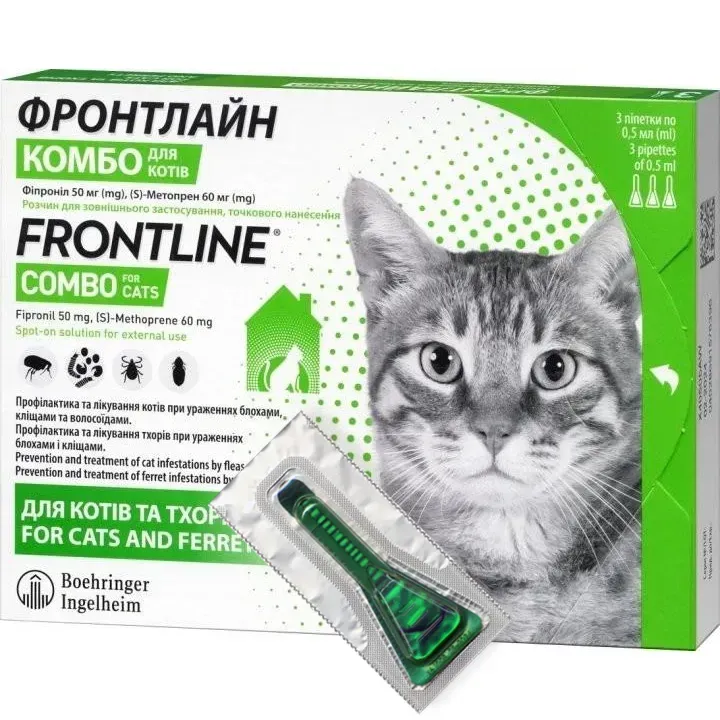
Frontline Combo Cat — spot-on drops against fleas and ticks for cats (0.5 ml × 1 pipette)
Buy - Systemic preparations (tablets, chewables) — enter the cat’s bloodstream, providing effect against adult fleas and their larvae when they begin feeding.
Recommended Products

Credelio — antiparasitic tablet for cats
Buy
Vitomax Okero — antiparasitic tablet for cats 0.5–2.5 kg with salmon flavor
Buy - Pheromone and insecticide sprays for the environment — destroy eggs and larvae in carpets, bedding, and floor cracks.
4. Integrated approach
Modern veterinarians recommend a comprehensive approach that considers the flea life cycle:
- Elimination of adult fleas on the cat (systemic or topical products).
- Blocking egg and larva development in the environment (sprays, carpet cleaning, bedding).
Recommended Products

AnimAll — gel for washing pet items
Buy - Prevention of reinfestation through regular treatments and control of contact with other animals.
This approach breaks the flea life cycle, reduces itching and disease risk, and keeps cats healthy and happy.
Supporting methods to manage flea dermatitis consequences
Flea dermatitis in cats is often accompanied by itching, skin redness, and fur damage due to scratching. In addition to fighting the fleas themselves, it is very important to support the skin, fur, and overall health of the cat to relieve unpleasant symptoms.
1. Fur care
Regular fur cleaning helps reduce irritation and prevent bacterial infections. It is recommended to use:
- Balms and conditioners without parabens, SLS, and “tearless” formulas that simultaneously moisturize and cleanse, being extremely gentle on the cat’s thin and sensitive skin;
Recommended Products

Shampoo “Perfect Care” for Dogs and Cats Total Care HOME FOOD Beauty, 200 ml
Buy
Conditioner “Silky Touch” for Dogs and Cats Silky Touch HOME FOOD Beauty, 200 ml
Buy - Gentle combing after washing to prevent matting and provide additional skin massage.
Recommended Products

Flea comb for cats
Buy
Trixie Soft Brush — soft slicker brush with rubber handle plastic/metal 12×16 cm
Buy
2. Detox support
To reduce allergic reactions and body intoxication after flea bites, Detox Pro can be used. It helps lessen allergy symptoms, relieve itching, and restore the skin’s natural protective function.

Enterosorbent for body detoxification Detox Pro HOME FOOD Expert, 30 ml
Buy
3. Relief of irritation
If the cat’s skin is severely irritated due to bites or scratching, Relax Pro helps calm the nervous system, reduce redness and inflammation, and speed up the healing process.

Dietary supplement CBD oil 2% to reduce anxiety and pain Relax Pro HOME FOOD Expert, 10 ml
Buy
4. Liver support
When using systemic antiparasitic products, especially long-term or repeated courses, it is helpful to support the cat’s liver. Liver Pro provides detoxification, helps the liver cope with the load, and supports metabolism.

Hepatoprotector for liver function support Liver Pro HOME FOOD Expert, 30 ml
Buy
Comprehensive use of these supportive methods helps the cat recover faster from flea dermatitis, reduce discomfort and itching, and maintain overall health and fur beauty.
Flea prevention: balancing recommendations and individual choice
We cannot unconditionally recommend using systemic antiparasitic drugs against fleas in cats year-round, as this always depends on the individual characteristics of the animal, its health status, lifestyle, and risk of contact with the external environment.
At the same time, European veterinary recommendations in the field of cat and dog health emphasize that systemic products can be used throughout the year, since fleas and other parasites can actively reproduce even in cold months indoors and in the home environment.
The decision on the frequency and duration of product use remains with the owner in consultation with the veterinarian, who takes into account:
- risk of infestation from contact with other animals;
- climatic conditions and seasonality of flea activity;
- cat’s health condition, age, and possible contraindications;
- presence of concurrent skin problems or allergies.
Thus, flea prevention is a comprehensive and caring approach that combines scientifically grounded recommendations with the individual needs of your pet. Thanks to this, the cat remains healthy, calm, and protected throughout the year.


