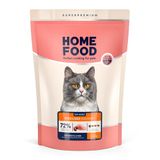
📌 HOME FOOD Blog: Dry or Wet Food for Cats — Which Is Better?
Dry or Wet Food for Cats — Which Is Better?
Navigating the world of cat nutrition today is no easy task. Store shelves offer dozens of brands, recipes, and formats of food, and cat owners are increasingly asking themselves: what should I choose — dry or wet food? Each option has its own advantages, features, and nuances that affect the health of the beloved pet.
In this article, we will figure out how these two types of nutrition differ, when each of them works best, and how to find the balance that will suit your furry friend. Let this guide be the first step toward a conscious choice and a happy purring life for your cat.
Brief historical background: from homemade meals to modern commercial feeds
Just a few decades ago, the question of choosing between dry and wet food didn’t even arise — most cats ate what their owners prepared. The diet included table scraps, cereals, boiled meat, sometimes fish or milk. This approach seemed natural, but it had a serious drawback: homemade food was rarely balanced, and a lack of certain vitamins, amino acids, or minerals could lead to health problems.
The discovery of the role of balanced nutrition
In the 20th century, veterinary science developed rapidly. Researchers found that cats are obligate carnivores, meaning their bodies require a specific set of nutrients, particularly taurine, fat-soluble vitamins, high-quality proteins, and a minimal amount of carbohydrates. It then became clear that ordinary homemade food could not fully meet these needs.
The appearance of the first commercial feeds
The first commercial cat foods appeared in the mid-20th century. At first, these were simple canned foods based on animal products. They already contained balanced proportions of nutrients, allowing cats to be fed without additional supplements.
In the 1960s–1970s, the market took a big step forward with the appearance of dry foods. They were convenient, had a long shelf life, were easy to dose, and quickly became popular among cat owners.
The modern stage: science + technology
Today, commercial feeds are the result of complex technological processes and decades of scientific research. Leading brands work with veterinary nutritionists, conduct clinical studies, and create diets taking into account the animal’s age, health status, activity level, and even breed. Specialized diets have appeared for cats with kidney disease, sensitive digestion, excess weight, or allergies.
Thus, the path from “table scraps” to specialized formulas is an evolution that has made cat nutrition safer, more precise, and much more beneficial. Today, owners have the unique opportunity to choose exactly the diet that best meets their pet’s needs.
What is the real difference between dry and wet food?
To understand why dry and wet food behave differently in the bowl and in the cat’s body, it’s worth looking into the process of their creation. Although both types of nutrition can be complete and balanced, the production technology, physico-chemical properties, and nutraceutical characteristics differ significantly.
How dry food is made
1. Extrusion — the heart of the technology
Dry food is created using the extrusion method: ingredients are ground, mixed into a moist paste, and then forced through molds under short-term temperature and pressure. Rapid cooling gives the granules their structure and hardness.

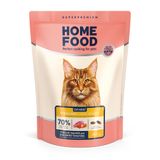
Dry food HOME FOOD for active adult cats Chicken and Shrimp For active, 1.6 kg
Buy
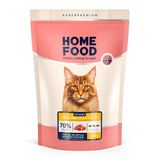
Dry food HOME FOOD healthy skin and shiny coat for adult cats Turkey and Salmon Healthy skin and shiny coat, 1.6 kg
Buy
Dry food HOME FOOD for neutered/spayed adult cats Rabbit and Cranberry For sterilised/neutered, 1.6 kg
Buy
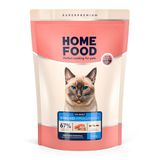
Grain-free hypoallergenic dry food HOME FOOD for adult neutered/spayed cats Duck and Pear Grain-free hypoallergenic. Suitable for exotic breeds, 1.6 kg
Buy
2. Minimal moisture
The finished product contains 8–10% water, which ensures a long shelf life and a crunchy texture.
Physico-chemical features of dry food
- low water activity — better stability and lower risk of spoilage;
- high energy concentration per gram;
- moderate carbohydrate content, as extrusion requires them to form granules;
- hard texture promotes mechanical teeth cleaning.
Nutraceutical characteristics
- more concentrated source of calories — important for active cats;
- possibility to add functional components: prebiotics, fiber, chondroprotectors;
- somewhat lower biological value of certain vitamins is compensated by adding them to the formula in the form of an “organic” or chelated premix.
How wet food is made
1. Gentle preparation and sterilization
Ingredients (meat, offal, broth, sometimes vegetables) are mixed in a more natural texture and cooked at lower temperatures than during extrusion. Then the food is packaged in cans, pouches, or trays and undergoes sterilization.
2. High moisture
Wet food contains 70–80% water, making it closer to the cat’s natural prey.
3. Fewer carbohydrates
The wet formula does not require starch to hold its shape, so the carbohydrate content is usually lower.
Physico-chemical features of wet food
- high moisture — better body hydration;
- higher water activity — requires sterilization for long shelf life;
- softer texture, closer to natural food;
- lower calorie content per gram of product.
Nutraceutical characteristics
- better bioavailability of some nutrients due to gentle processing;
- advantage for cats that drink little or are at risk of urological problems;
- high aroma and taste appeal;
- easier weight control due to lower calorie content.
So: key differences
- Dry food — concentrated, energy-dense, technologically processed under pressure, with low moisture.
- Wet food — more natural in texture, wetter, less caloric, and with gentler heat treatment.
Both types can be high-quality: the main thing is the composition and compliance with the cat’s specific needs.

Complete canned food HOME FOOD for adult cats with turkey and chicken in sauce, 85 g
Buy
Complete canned food HOME FOOD for adult cats with beef and salmon in jelly, 85 g
Buy

How to choose your path in feeding a cat: dry, wet, or mixed diet?
Every cat is unique, and there is no single correct feeding option for all. All types of diets have the right to exist if they are balanced and chosen with care. Below is a professional guide that will help you find the best approach for your pet.
Feeding only dry food
This option is convenient for the owner and suitable for cats that drink water well.
Advantages:
- stability of the diet and ease of dosing;
- helps control weight with the right food;
- suitable for all age categories.
Important:
The cat must have unrestricted access to clean water — fountains or several bowls in different rooms are highly recommended.
Who it suits:
Healthy cats, young and adult animals with good water balance.
Feeding only wet food
This is the most natural texture and moisture feeding method, which perfectly supports the cat’s hydration.
Advantages:
- high moisture reduces the risk of crystal and stone formation in the urine;
- aroma improves the appetite of picky cats;
- lower calorie content helps control weight.
Important:
Make sure the food is complete, not supplementary.
Who it suits:
Cats with a tendency to urolithiasis, elderly animals, cats with low activity, fluffy cats that drink little.
Mixed feeding: dry + wet food
This is a compromise that combines the best of both worlds. Many veterinarians recommend this approach.
Optimal proportions
- 50/50 by calories — the classic option;
- 25% dry + 75% wet — for cats that need additional hydration;
- 75% dry + 25% wet — for high activity and good drinking regime.
Important: focus on calorie content, not gram weight, as dry food is much more energy-dense.
Advantages:
- supports water balance;
- allows alternating textures and flavors, maintaining interest in food;
- provides optimal satiety.
Who it suits:
Most healthy cats — this is a flexible and balanced option.
Homemade (hand-prepared) food + commercial feed
This approach is possible but requires caution. Homemade dishes are often not balanced in minerals and vitamins, so their share should be moderate.
Recommended proportions
- No more than 10–20% homemade food from the daily ration if it is not calculated by a veterinary nutritionist.
- If you want to increase the share — the recipe should be compiled individually with a specialist.
Advantages:
- ability to control ingredient quality;
- sometimes useful for allergies (e.g., a diet with a single protein).
But it is important to remember:
- homemade food without special supplements does not cover the cat’s needs for taurine, calcium, vitamins D and group B, as well as the correct ratio of calcium and phosphorus;
- a sharp decrease in the share of commercial food can lead to imbalance.
Who it suits:
Cats with food allergies or special needs — but only under specialist supervision.
What to choose?
Look at your cat’s lifestyle, health condition, and habits.
- Active young cat? — dry or mixed diet is suitable.
- Drinks little, has risks of urolithiasis? — better wet or 75% wet.
- Picky gourmet? — mixed feeding with alternating textures.
- Special dietary needs? — homemade food only on the recommendation of a veterinarian.
The most important thing is to feed with love, respect for the cat’s natural needs, and consideration of its individuality. Only then will the diet become not just “food,” but a daily contribution to the health and happiness of your tailed friend.
When does your cat need additional supplements?
Although high-quality complete food already contains everything necessary for health, there are situations when a cat needs additional support. The main thing is to do it consciously, delicately, and under the guidance of a veterinarian, because an excess of microelements can be no less harmful than their deficiency.
Below is a clear and professional overview of cases when it is worth introducing vitamin-mineral or specialized supplements.
1. When are vitamin-mineral complexes needed?
For self-prepared diets
Homemade food, even very high-quality, is almost never balanced for cats in terms of:
- taurine
- calcium and phosphorus (and their correct ratio),
- vitamins A, D, group B,
- microelements (zinc, copper, manganese).
If homemade food makes up more than 20% of the diet — multivitamin supplements for cats are mandatory.

Salmon oil for skin health and shiny coat in dogs and cats, 100 ml
Buy
Phytomin for cats HOME FOOD “Krill” oil for recovery after shedding, 100 ml
Buy
If homemade menu >50% — it is advisable to create an individual formula with a nutritionist.
For chronic diseases
The body needs additional support in cases of:
- kidney diseases (omega-3, antioxidants)
- liver diseases (B vitamins, L-carnitine, betaine)
- diabetes (certain type of fiber, detox support)
- heart problems (taurine, carnitine).
During recovery after illness or surgery
Then you need:
- enhanced group B
- antioxidants
- prebiotics for intestinal function
- additional energy sources
In senior cats
With age, the need increases for:
- glucosamine and chondroitin (joints)
- omega-3 (anti-inflammatory effect)
- adaptogens (brain and nervous system support).
2. When are specially targeted supplements needed?
Cannabidiol (CBD) — for calming and stress relief

Dietary supplement CBD oil 2% to reduce anxiety and pain Relax Pro HOME FOOD Expert, 10 ml
Buy
CBD is used in cases of:
- anxiety,
- fear of loud sounds,
- adaptation to moving or a new home,
- chronic stress or aggression.
Immunobiotics for mixed feeding type

Probiotic and enzymes for restoring intestinal microbiota ImmunoBiotic Pro HOME FOOD Expert, 20 g
Buy
When the diet consists of different textures and types of food, the cat’s intestines may need support.
Immunobiotics are complexes with probiotics and digestive enzymes that:
- strengthen local immunity in the intestines,
- facilitate the transition between foods,
- help avoid diarrhea or soft stools when changing the diet.
Especially useful for mixed feeding or partial introduction of homemade food.
Symbiotics (combination of probiotics + prebiotics) for digestive disorders

Enterosorbent for body detoxification Detox Pro HOME FOOD Expert, 30 ml
Buy
Symbiotics are recommended if you notice:
- periodic diarrhea or constipation,
- bloating, gas,
- unstable stool,
- sensitive stomach.
They help:
- restore the microbiota,
- improve digestion,
- reduce inflammation in the intestines,
- stabilize stool.
When are supplements not needed?
- when the cat receives only complete super-premium commercial feeds
- there are no health problems,
- appetite and stool are stable,
- coat is shiny, behavior is calm.
The most important thing is to listen to your cat
If you notice changes in appetite, coat, behavior, or digestion — this is a signal that the body needs help. Properly selected nutraceuticals can become caring support and significantly improve quality of life.
Feed with love, observe with attention — and your purring friend will always feel harmonious and protected.