📌 HOME FOOD Blog: How to Remove a Tick from a Cat
How to Remove a Tick from a Cat
Ticks are small but extremely dangerous parasites that can cause serious harm to our pet's health. If you notice a tick on your cat's skin, act quickly but calmly. Proper and safe removal of the parasite will help avoid serious complications and preserve your cat's health. In this article, we will explain in detail how to carefully remove a tick, what to pay attention to, and which mistakes to avoid.
Why ticks are a danger all year round, even for indoor cats
When ticks are active, and why the risk doesn't disappear with winter or living in an apartment
- Although traditionally considered a seasonal threat (spring, summer, autumn), in reality some tick species in our climate remain active year-round. For example, studies in western Ukraine have shown that the tick Dermacentor reticulatus was found on animals in any month, even in winter.
- If your cat is indoor but you live, say, near a garden, forest belt, city park, or have a dacha, the risk exists even without long walks in nature. Ticks can be carried — for example, on shoes, clothing, on the fur of domestic or stray animals brought from outside, and end up in the yard, on the lawn, in the garden, or even near the house. In other words — not only "street" cats, but also indoor cats in apartments or with access to a yard should stay alert.
- Also in cities and parks — not only nature: studies show that ticks are found on city lawns too. Therefore, even living in the city doesn't give 100% guarantee if the cat walks in the yard or spends time on the balcony, in the yard, or near green areas.
How common are ticks in Ukraine — what the statistics say
- There is a scientific study Ixodid ticks in the Western Ukraine (covering 2018–2019), which collected ticks from domestic animals — dogs and cats, as well as from cattle and wild animals. It states that among the collected ticks — from cats: 4 ticks of the species Ixodes hexagonus (0.1% of the total collected ticks) and ticks of the species Ixodes ricinus — 58% of the ticks removed from cats.
- In the same study, the authors report that the average "tick load" per cat is approximately 2 ticks per animal.
Main tick species dangerous for cats
In Ukraine (and generally in Europe), the following species of ixodid ticks are most commonly found on cats:
1) Ixodes ricinus (European forest tick)
The most common species in Europe and Ukraine. Very active in humid areas: parks, forest belts, city lawns.
2) Dermacentor reticulatus (meadow tick)
Likes open areas, meadows, fields, roadsides. Due to mild winters in Ukraine, it is active almost year-round.
3) Ixodes hexagonus (hedgehog tick)
Typical for hedgehogs and foxes, but often parasitizes cats too, especially those walking near forest belts or private yards.
4) Rhipicephalus sanguineus (brown dog tick)
Common in southern regions; capable of living indoors (!) — basements, animal shelters. Can jump onto cats as well.
What diseases do ticks carry (threat to cats and humans)
We present scientifically confirmed pathogens carried by ixodid ticks in Europe and Ukraine. Some of these diseases are rare in cats, but cats can be carriers even if they do not get sick themselves.
1. Lyme disease (Borrelia burgdorferi s.l.)
Vectors: Ixodes ricinus
For cats: clinical cases are rare but possible.
Symptoms in cats: lameness, joint pain, fever, lethargy.
2. Anaplasmosis (Anaplasma phagocytophilum)
Vectors: Ixodes ricinus
For cats: clinical cases described.
Symptoms: apathy, fever, lethargy, anorexia, sometimes jaundice.
3. Ehrlichiosis (Ehrlichia canis, E. chaffeensis)
Vectors: Rhipicephalus sanguineus
For cats: occurs less frequently but confirmed by lab tests.
Symptoms: emaciation, bleeding, anemia, depression.
4. Babesiosis (Babesia spp.)
Rare in cats in Europe, but cases of infection described in neighboring regions and in Ukraine among wild felines.
Vectors: Dermacentor spp., Rhipicephalus sanguineus
Symptoms: high fever, severe apathy, anemia, jaundice — severe course.
Note: Babesiosis is very common in dogs, much rarer in cats, but the risk exists.
5. Rickettsioses, hemobartonellosis (Rickettsia helvetica, R. raoultii, Mycoplasma haemofelis)
Vectors: Ixodes ricinus, Dermacentor reticulatus
Cats can be both carriers and occasionally get sick.
Symptoms: fever, enlarged lymph nodes, lethargy.
6. Cheyletiellosis (“walking dandruff” — Cheyletiella spp.)
These are not ixodid but fur mites, but still important.
Vectors: direct contact, non-ixodid mites.
Symptoms: dandruff, itching, skin irritation.
Can be transmitted to humans.
7. Ear mite (Otodectes cynotis)
Also not ixodid, but one of the most common.
For cats: causes otodectosis — ear inflammation.
Symptoms: itching, head shaking, accumulation of dark “coffee-like” secretion.
Not every tick is infected, but why it is still important to remove it
Many owners worry: “If the cat brought a tick — is it definitely an infection?” In reality — no. And it is important to understand this to avoid panic but act correctly.
1. Not every tick carries dangerous pathogens
In nature, there are many tick species, but only a portion are infected with disease agents.
Even among “dangerous” species (Ixodes, Dermacentor, Rhipicephalus), not all individuals carry infection.
According to scientific data, in different regions of Europe and Ukraine, tick infection rates with pathogens range from 5% to 40%, depending on the species and area.
So the chance of encountering an infected tick exists, but it is not 100%.
2. Even if the tick is infected, transmission does not happen instantly
Most pathogens are transmitted not immediately, but after a certain time when the tick has already attached and started actively feeding on blood.
For example:
- Borrelia (Lyme disease) — usually transmitted 12–24 hours after attachment.
- Anaplasma — within 4–24 hours.
- Some other pathogens — faster, but still not instantly.
This means that quick tick removal significantly reduces the risk of infection.
3. Why is it important to remove the tick as soon as possible?
1. Reducing infection risk
The longer the tick feeds on blood, the higher the chance of transmitting the pathogen. Quick removal = fewer chances of disease.
2. Reducing local reactions to the bite
Cats often experience:
- inflammation,
- swelling,
- itching,
- formation of a “bump” that may not heal.
This is the result of the tick injecting enzymes that thin the blood and its own saliva that irritates tissues.
3. Preventing secondary bacterial infections
If the tick remains in the skin for a long time, the bite site may develop:
- pus formation,
- dermatitis,
- bacterial infection.
4. The cat may accidentally scratch or bite off the tick
This is dangerous because:
- the tick's mouthparts may remain in the skin,
- inflammation risk increases,
- the cat may accidentally swallow the tick (undesirable, though not fatal).
5. Some ticks may move around the body looking for a “better” bite site
Therefore, even if the tick has not yet attached, it is worth removing it immediately.
How to properly remove a tick from a cat: step-by-step instructions
Removing a tick from a cat is not difficult if done carefully and correctly. Here is a clear and safe instruction.
Step 1: Prepare everything you need
You will need:
- a special tick hook/lasso,
- or thin tweezers with narrow tips;
- disposable gloves;
- antiseptic;
- tissues or cotton pads;
- a small container/jar (to keep the tick in case symptoms appear in the cat).

Trixie Tick Away Remover - tick removal tool, hook-shaped, 6.5 cm
Buy
Topical Antibiotic Floxy-Spray Max BioTestLab for Dogs and Cats, 9 ml
Buy
Step 2: Secure the cat without stress
Best if someone holds the cat by the body and front paws.
You can wrap the cat in a towel, leaving only the head and bite area — this is safe and calming.
Step 3: Find the tick and part the fur
Ticks most often hide:
- behind the ears,
- on the neck,
- on the face,
- under the armpits,
- between the toes,
- in the groin area,
- along the spine.
Part the fur and assess how deeply the tick is attached.
Step 4: Properly grasp the tick
If using a tick hook:
- slide the hook under the tick's body between the skin and its mouthparts;
- gently twist the hook 2–3 times, do not pull vertically;
- the tick will come out on its own along with the mouthparts.
If using tweezers:
- grasp the tick as close to the skin as possible — by the head/mouthparts, not the abdomen;
- pull steadily upward, without jerking;
- do not squeeze hard — to avoid crushing the tick.
Step 5: Make sure the tick is completely removed
If a black dot remains in the skin — it may be part of the mouthparts.
A small fragment is not life-threatening but can cause inflammation.
You can:
- carefully remove it again with sterile tweezers or
- leave it and let the skin reject the fragment within 1–3 days.
Step 6: Treat the bite site
Use an antiseptic.
Do not use brilliant green or iodine — they irritate cat skin.
Step 7: Save the tick (optional)
Place the tick in a small jar.
It may be needed if symptoms appear within 1–14 days:
- lethargy,
- fever
- loss of appetite,
- lameness
- jaundice
- enlarged lymph nodes.
Then the veterinarian can send the tick for analysis.
Step 8: Monitor the cat for 2 weeks
Symptoms of tick-borne diseases may not appear immediately.
If any behavior changes occur, it is better to consult a veterinarian.

Typical owner mistakes when removing a tick
To avoid harming your cat, avoid these common mistakes.
1. Smearing the tick with oil, alcohol, cream
This makes the tick “suffocate,” but before dying it releases more saliva and pathogens into the wound.
Infection risk increases.
2. Twisting with sharp movements
Jerking or sharp twisting can tear off the mouthparts.
This causes:
- inflammation
- pus formation
- bump formation,
- prolonged healing.
3. Squeezing the tick by the abdomen
Inside the tick — blood, pathogens, bacteria.
If crushed — all this can enter the wound directly.
4. Using a needle, scissors, own fingernails
You can injure the cat's skin and introduce infection.
5. Attempting to “pull the tick out with a magnet” or wash it off with water
This does not work.
The tick is firmly attached by its mouthparts.
6. Not treating the bite site after removal
Antiseptic reduces infection risk and speeds healing.
7. Ignoring symptoms after the bite
Most diseases appear within 3–14 days, so monitoring is an important part of prevention.
Prevention: how to protect your cat from ticks year-round
Preventing a bite is always easier and safer than treating the consequences. Modern veterinary products allow protecting cats almost 100% if used correctly.
1. Spot-on parasitic drops
The most popular and safe option for cats.
Advantages:
- act for 3–4 weeks,
- protect against ticks, fleas, and sometimes mosquitoes,
- easy to apply.
Important:
- apply only to the skin, not the fur;
- do not bathe the cat for 48 hours after application;
- choose products only labeled “for cats” (dog products can be toxic!);
- if drops are intended for cats weighing 2.5–5 kg and your cat weighs 2.5 kg (not 2.4!), choose drops with the 2.5–5 kg range.
2. Tick collars
Work from 6 to 8 months (depending on the brand).
Advantages:
- long-term protection,
- convenient for cats that go outside,
- evenly release the active substance.
Important:
- ensure the collar fits snugly but does not press;
- remove during bathing (depends on the model).
- avoid leaving the cat in the collar for long periods under direct sunlight (risk of allergy, burn).
3. Tablets
Advantages:
- work systemically,
- provide long protection (4–12 weeks),
Important
- prescribed only after consultation with a veterinarian.

Vitomax Sempero — antiparasitic collar for cats and small dog breeds against fleas and ticks, orange (35 cm)
Buy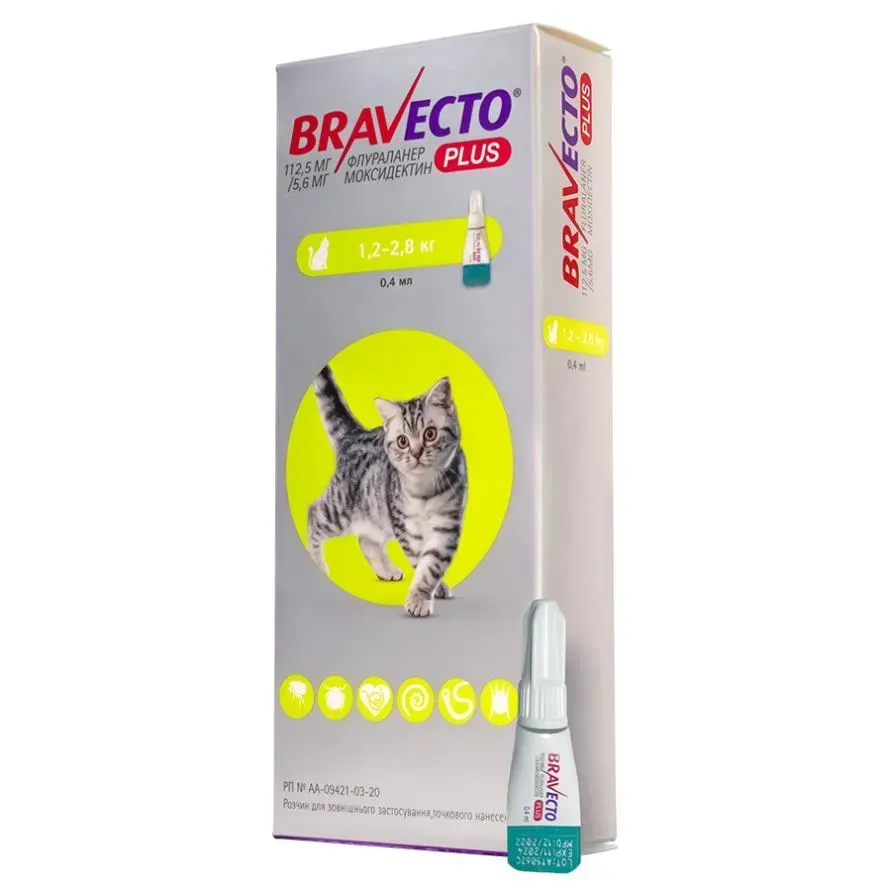
Bravecto Plus — spot-on parasitic drops against fleas, ticks, and worms for cats 1.2–2.8 kg, 112.5 mg
Buy
KRKA Prinocate Cat — spot-on parasitic drops against fleas, ticks, and helminths for cats and ferrets up to 4 kg, 1 pipette
Buy
Credelio — antiparasitic tablet for cats
Buy
4. Regular cat inspection
After going outside or walking in the yard, check:
- neck
- head
- face
- belly
- between toes,
- armpits
- tail area.
5. Yard maintenance
If the cat walks in your own yard, it is worth:
- mowing the grass,
- removing weeds,
- preventing leaf accumulation,
- treating the area with tick repellents (safe for animals).
6. Preventive veterinary check-ups
Every 6–12 months it is worth doing:
- examination,
- blood test (if parasites are suspected),
- consultation on protection.
This helps detect diseases that may remain asymptomatic for a long time
What to do if symptoms appear after a tick bite?
Even if the tick was removed promptly, monitor the cat for 14 days. Some infections have an incubation period.
What the veterinarian will do:
- conduct an examination, measure temperature,
- perform blood tests (general, biochemical),
- may prescribe PCR (ELISA) test / blood smear for:
- Mycoplasma haemofelis (hemobartonellosis),
- Anaplasma
- Ehrlichia,
- Borrelia,
- Babesia (if suspected).
The earlier the infection is detected — the easier and faster it can be treated.
Do not self-medicate!
- Antibiotics,
- antiparasitic drugs,
- steroids
— can cause harm if chosen incorrectly.
Accurate diagnosis → accurate treatment → quick recovery.