HOME FOOD Blog: Why Does a Cat Hiss?
Why Does a Cat Hiss?
“When a cat hisses, it speaks a language that only those willing to listen will understand.”
Historical Background: Cat Hissing Through the Lens of Time
Hissing in cats is a behavioral mechanism that has existed for thousands of years and traces back to the evolution of predators. Even the wild ancestors of domestic cats had to protect their territory, resources, and offspring, and hissing became an effective way to warn enemies and competitors without physical contact.
Throughout history, people noticed this sound and tried to interpret it in their own way. In Ancient Egypt, where cats were considered sacred, hissing was seen as a sign of self-defense and strength — it was respected because it meant the cat felt threatened. In medieval Europe, the sound was often associated with fear or aggression and became part of folklore about “unfriendly” cats.
From the perspective of modern ethology, hissing is a universal communication strategy that helps cats avoid conflict and express emotions. It combines elements of fear, aggression, and self-preservation signaling.
Thus, hissing is not just a “bad temper” or whim — it’s an innate, historically ingrained behavior that helps cats survive and communicate in a world where every sound matters.
In this blog post, we’ll explore why cats hiss, what emotional and physiological reasons lie behind this sound, and how owners should properly respond so as not to provoke stress in their pet.
Why Does a Cat Hiss: Emotional, Physiological, and Anatomical Causes
Hissing is a complex signal that combines emotional state, physiological response, anatomical features, and instinctive behavior.
The Anatomy of Hissing
Hissing is produced through special coordination of the respiratory system and vocal cords. When a cat feels threatened or stressed:
- The laryngeal muscles tense, the vocal cords narrow, creating the characteristic sound.
- A rapid exhalation of air through the narrowed vocal apparatus amplifies the hiss, giving it sharpness and an alarming tone.
- At the same time, the muscular corset of the neck and body tenses, enhancing the signal.
Emotional Causes of Hissing
- Fear and Anxiety
- The cat hisses when it feels threatened or unsafe.
- It’s a natural way of saying “stay away” without physical conflict.
- Aggression or Territorial Defense
- Hissing signals to other animals or people that the territory is protected and danger is possible.
- Frustration or Discomfort
- May occur during play or when movement is restricted, as the cat tries to express displeasure.
Physiological Causes of Hissing
- Pain or Illness
- Cats hiss when in pain, signaling physical discomfort.
- Reaction to Stimuli
- Sudden sounds, lights, smells, or unfamiliar objects activate the sympathetic nervous system.
- Hormonal Fluctuations
- Unspayed/unneutered or sexually mature cats may hiss in conflict situations due to hormonal changes.
Should You Suppress a Cat’s Hissing and How to Respond Correctly?
Hissing is often perceived as “bad behavior” or insolence, but from the standpoint of ethology and training, it is a natural and important form of communication. The owner’s task is not to punish the cat or force it to be silent, but to learn how to respond correctly and support the cat’s emotional balance.
Ethological Approach
Suppressing or punishing hissing can:
- Increase stress and fear in the animal.
- Damage trust between the cat and the owner.
- Lead to more aggressive or covert reactions in the future.
Training Approach
- Calmness and Gradualness
- If the cat hisses — do not approach abruptly and do not punish. Let it retreat and calm down.
- Positive Reinforcement of Calm Behavior
- Reward calm behavior or acceptance of closeness without hissing with affection or treats.
- Removal of Triggers
- Minimize stressors (loud noises, sudden movements, invasion of personal space).
- Teaching Alternative Signals
- Gently teach the cat to express displeasure in other ways (walking away, turning away).

Can excessive hissing be corrected with treats and supplements?
Sometimes a cat hisses more often than we’d like, even when there is no real threat. In such cases, you can gently reduce anxiety and nervous tension with the help of treats and special supplements.
Treats for Stress Relief
- Give the cat pleasure and distract from stressful situations.
- Easy to chew, stimulate jaw work and help relieve tension.
- Used as a short-term positive signal.
- Choose specialized cat treats without excess sugar or artificial flavors.

HOME FOOD Protein Cookies with Turkey for Cats, 80 g
Buy
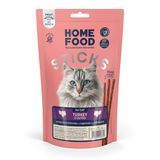
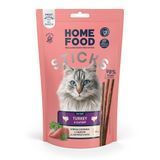
HOME FOOD Cat Treats – Turkey Meat + Catnip Jerky Sticks, 40 g
Buy
Supplements for Emotional Balance
1. Cannabidiol (CBD)
- Provides a mild calming effect, reduces nervousness and anxiety.
- Used in drop form under veterinary supervision.

CBD Oil 2% Dietary Supplement for Anxiety & Pain Relief Relax Pro HOME FOOD Expert, 10 ml
Buy2. 5-Hydroxytryptophan (5-HTP)
- A precursor to serotonin, helps normalize the cat’s mood.
- Suitable for nervous system support during stressful situations.

Adaptogen for Nervous, Endocrine & Immune System Support Harmony Pro HOME FOOD Expert, 20 g
BuyHow to Properly Use Treats and Supplements
- Use as part of a comprehensive approach together with positive reinforcement of calm behavior.
- Never give supplements as “punishment” or immediately after hissing — this can worsen perception.
- Always monitor dosage and consult a veterinarian.
Treats and specialized supplements can be a gentle and safe way to help a cat stay calm when used wisely and in combination with proper handling and a safe environment. This reduces the frequency of hissing without suppressing the animal’s natural emotions and supports its emotional well-being and trust in the owner.