Demodicosis in dogs often begins unnoticed: a small bald patch, slight redness, somewhat rougher skin. But behind such changes there may be a parasitic disease that sometimes passes easily and sometimes requires long-term controlled therapy.
To avoid missing the problem, it is important to understand how puppies become infected, when demodicosis occurs in adult dogs, which symptoms should raise concern, and why the diagnosis can be confirmed only through veterinary tests.
In this article, we will discuss the causes, forms of the disease, symptoms, diagnosis, treatment approaches, duration of monitoring, and prognosis for dogs of different ages.
What demodicosis in dogs is
Demodicosis is a parasitic skin disease in dogs caused by microscopic mites of the genus Demodex, which live in hair follicles and sebaceous gland ducts, while some species live in the superficial layers of the skin.
Several species of Demodex mites have been described in dogs: Demodex canis, Demodex injai and Demodex cornei. Most often, the condition discussed is demodicosis caused by D. canis.
Puppies become infected from their mother in the first days of life through close contact. In healthy animals, the number of mites is usually small and does not cause clinical signs because the immune system keeps their population under control.
- In puppies, demodicosis most often appears between 3 and 18 months of age.
- In adult dogs, the disease more often occurs after 4 years of age and is often associated with immune problems.
- The mere presence of Demodex mites does not always mean disease: the key issue is uncontrolled mite multiplication.
Forms of the disease
Demodicosis occurs in two main forms. The form of the disease largely determines how difficult treatment will be and what prognosis to expect.
| Form | What the owner usually sees | What is important to know |
|---|---|---|
| Localized | Small limited affected areas, moderate hair loss, mild or absent itching | Often seen in puppies and may resolve on its own when the immune system normalizes |
| Generalized | Many lesions across the body, skin inflammation, comedones, papules, pustules, sometimes purulent lesions | Requires complex therapy; in adult dogs it is almost always secondary and requires looking for an underlying cause |
| Generalized in adult dogs | Worsening skin condition against a background of weakness, chronic disease, or long-term medication therapy | Common causes include endocrine diseases, tumors, glucocorticosteroid therapy, and immunosuppressive states |
In a severe course of the generalized form, fever, lethargy, enlarged lymph nodes, and skin swelling may occur.
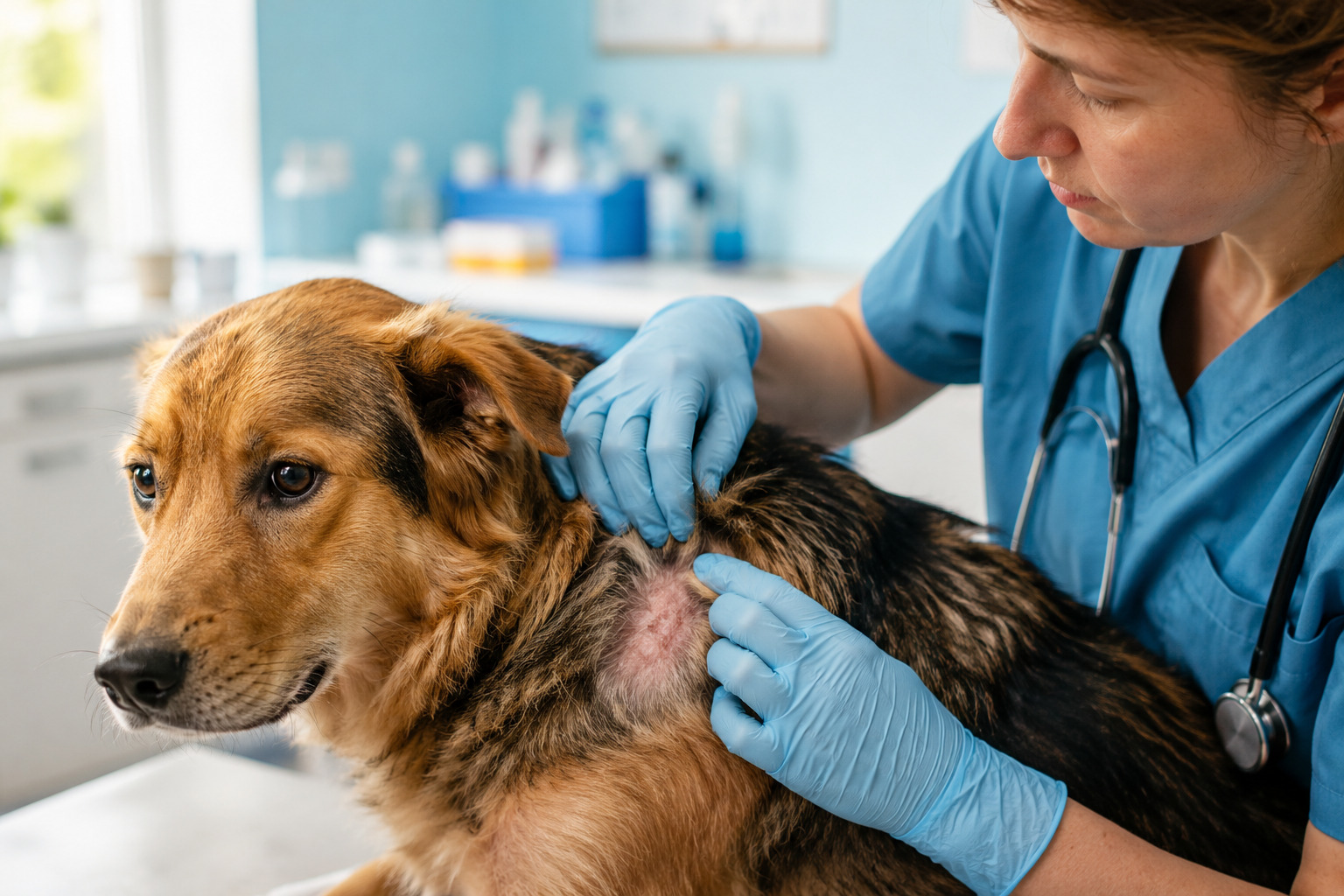

The most deceptive thing about demodicosis is that at first it may look like a minor cosmetic problem, while the generalized form already requires systemic treatment and a search for the cause of impaired immune control
Symptoms of demodicosis
The onset of the disease usually looks like a small patch with thinning hair and mild skin redness. Over time, the area enlarges and the inflammation becomes more noticeable.
The first lesions most often appear on the muzzle and around the eyes, but lesions may also occur on the paws, ears, and body. As the process progresses, the owner may notice the following changes:
- Hair loss, or alopecia.
- Thickening of the skin, or lichenification.
- Redness and inflammation of the skin.
- Black dots, or comedones.
- Papules, pimples, pustules, and an unpleasant smell with secondary infection.
If a bacterial infection joins the parasitic process, the clinical picture becomes more severe. It is then that itching, pain, and oozing lesions may increase quite quickly.


HOME FOOD — dry food for small-breed puppies, lamb and rice
Buy
HOME FOOD Healthy skin and shiny coat — dry food for adult small-breed dogs
Buy
Harmony Pro HOME FOOD Expert — anti-stress feed supplement, 20 g
Buy
HePawSyn HOME FOOD Expert — symbiotic for digestive and immune support
Buy
Diagnosis
An accurate diagnosis is made by a veterinary dermatologist. By external signs, demodicosis can be confused with other skin diseases, so an examination alone is not enough.
To confirm the disease, the veterinarian usually uses several methods:
History taking
This helps rule out other skin diseases with a similar picture and assess the dog’s age, duration of symptoms, and possible concurrent diseases.
Deep skin scraping
The main method of detecting Demodex canis. The scraping is performed until a drop of blood appears in order to capture the hair follicles where the mites live.
Trichogram
Hair plucking is used in delicate areas, such as near the eyes or between the toes, where deep scraping is inconvenient.
Histological examination
Needed in complex cases when the skin is very thickened or the inflammation has become chronic.
In some situations, for example with severe skin pain or if the dog reacts aggressively to handling, tests may be performed under sedation.
Is demodicosis contagious?
Demodicosis is not dangerous to humans or other animals in the everyday sense. The parasites are transmitted only from the mother to puppies and only among dogs. That is why isolation from people or, for example, from a cat in the home is usually not needed.
- Demodicosis does not pose a threat to humans.
- Other pets do not become infected from a sick dog the way they might with some fungal or flea-related problems.
- The key task with demodicosis is not quarantine, but accurate diagnosis and proper treatment.
Treatment of demodicosis
Treatment strategy depends on the dog’s age, the form of the disease, and the animal’s general condition. Mild localized forms in puppies often resolve without active intervention, while generalized cases require complex therapy and veterinary supervision.
If a secondary bacterial infection, or pyoderma, is present, additional treatment is prescribed to eliminate it: special shampoos, local skin care, and antibiotics when indicated.
Among the agents that may be used for demodicosis, veterinarians consider different groups of medications and active substances. These include amitraz, macrocyclic lactones, combinations of moxidectin + imidacloprid, and isoxazolines. But the specific choice, dosage, and duration of the course are determined only by a doctor.

The main mistake with demodicosis is treating only the skin externally. In the generalized form, the veterinarian works simultaneously with the parasite, the secondary infection, and a possible underlying cause of weakened immunity

MSD Animal Health Bravecto — Bravecto tablet against fleas and ticks for dogs
Buy
Elanco Advocate — Advocate antiparasitic spot-on drops for dogs
Buy
Zoetis Stronghold — Stronghold antiparasitic drops for dogs
Buy
Elanco Credelio Plus — Credelio Plus antiparasitic tablet for dogs
Buy
Treatment duration and monitoring
One of the main causes of relapse is stopping therapy too early. Even if the skin already looks much better externally, mites may remain.
Therefore, the veterinarian continues treatment until two negative scrapings are obtained one month apart. In practice, the course may last from several weeks to several months.
Some dogs, especially herding breeds, may need a genetic test for the MDR1 mutation before certain medications are prescribed, in order to avoid severe side effects from specific active substances.
- Improvement in the skin’s appearance does not yet mean the end of treatment.
- Control scrapings are needed so therapy is not stopped too early.
- In adult generalized demodicosis, it is important to look for and manage the underlying disease at the same time.
Prognosis
The localized form in puppies usually has a favorable prognosis and often resolves without treatment. The generalized form in young dogs can also be curable with properly selected therapy.
In adult dogs, the prognosis largely depends on whether the underlying disease that undermines immune protection can be identified and controlled.

HOME FOOD oil "Sesame" — Phytomin for normalizing gastrointestinal function
Buy
HOME FOOD oil "Omega Balance" — Omega-3, -6, -9 balance
Buy
Cortavance Virbac — spray for treating dermatoses in dogs, 76 ml
Buy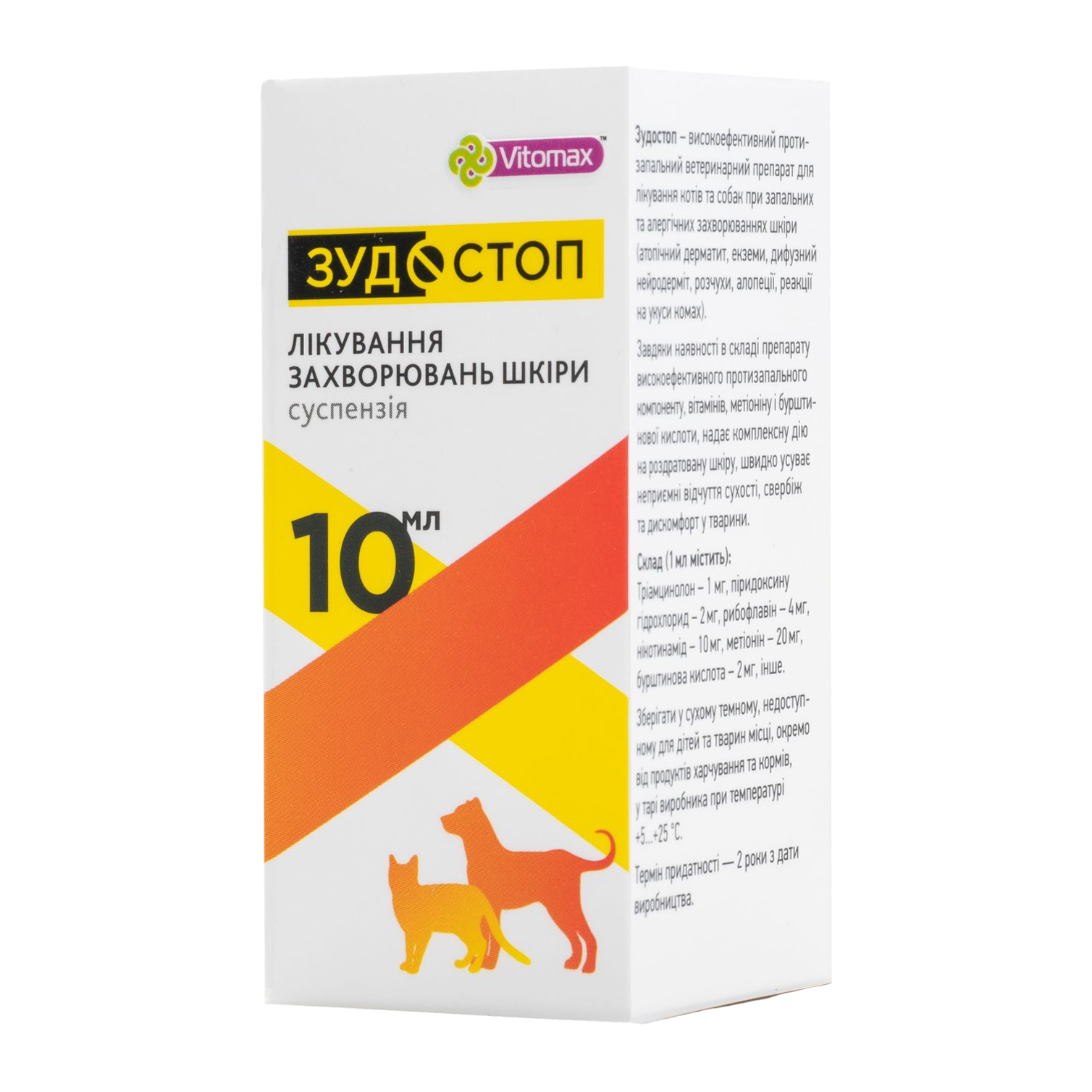
Zudostop Vitomax — product for dogs and cats, 10 ml
Buy
Conclusion
Demodicosis in dogs is not a sentence, but it is a disease that requires an attentive approach, accurate diagnosis, and strictly individual treatment selection. This is especially important in generalized forms and in adult animals, where the disease is often only the visible part of a deeper problem.
Self-treatment here is not only ineffective, but sometimes dangerous. If you notice bald patches, skin inflammation, comedones, or pustules, the best decision is to contact a veterinarian as soon as possible and undergo full diagnostics.