📌 HOME FOOD Blog: Can Cats Eat Corn?
Can Cats Eat Corn?
Corn has long been an integral part of the human diet and that of many domestic animals. But is it safe to give it to cats? At first glance, a small piece of boiled corn seems like a harmless addition, but a cat’s body has its own characteristics: they are obligate carnivores, and most of their energy should come from animal proteins. In this article, we will figure out when corn can be safe, which forms are suitable for cats, and when it is better to refrain from giving it so as not to harm your pet’s health.
Historical background: corn in animal diets
Corn is one of the oldest crops, domesticated more than 7,000 years ago in Mexico. Initially, it was grown for human needs, but already in the 19th–20th centuries it began to be actively used as feed for farm animals.
Which animals were given corn
- Cattle — as a source of energy and easily digestible carbohydrates.
- Pigs — corn feed provided rapid weight gain.
- Chickens and other poultry — to improve egg production and weight gain.
- Horses — as an additional source of calories for work and competitions.
Forms of corn in feeds
In commercial compound feeds, corn can be presented as:
- Whole grain, sometimes pre-soaked or crushed.
- Coarsely or finely ground grain, which facilitates digestion.
- Corn flour or granules — convenient for mixing with other feed components.
The function of corn in feeds
- Energy source — high starch concentration provides the caloric content of the diet.
- Regulation of feed structure — ground grain helps form the granule of dry food and maintain its strength.
- Additional nutrients — small amounts of protein, fiber, B vitamins, and minerals.
Thus, corn has become a universal component of feeds for many animals, primarily as an energy supplement rather than the main source of protein.
Properties of corn as a cereal and the mechanisms of its digestion in cats
Corn is an annual grain crop with a high starch content (50–70%), proteins (7–10%), a small amount of fats (4–5%), and fiber (2–4%). It also contains B vitamins, minerals (magnesium, phosphorus, potassium), and antioxidants such as lutein and zeaxanthin.
Features of corn for cats
For cats, corn is not a natural food product. Their body is adapted mainly to digesting animal proteins and fats. Cats digest corn starch less efficiently than herbivores or omnivores.
Mechanisms of corn digestion in cats
- Starch breakdown
- In a cat’s stomach, corn starch is practically not digested.
- The main breakdown occurs in the small intestine under the action of the enzyme amylase. However, endogenous amylase in cats is less active than in dogs or humans, so starch digestibility is limited.
- Corn proteins
- The main protein is zein, which has low biological value for cats because it contains few essential amino acids such as taurine, methionine, and lysine.
- Therefore, corn protein cannot replace animal protein and is used mainly as an auxiliary source of nitrogen.
- Fiber
- It is partially broken down by bacteria in the large intestine, promoting moderate digestion, but does not provide significant energy value.
Corn can provide energy through starch and a small amount of protein, but its digestibility in cats is limited. That is why it is used as an auxiliary ingredient in feeds or a minor flavor additive, but never as the main source of nutrients in the diet of an obligate carnivore.
Is corn suitable for cats and in what forms?
Forms of corn that may be safe
- Boiled or baked corn without salt, spices, oil, or sugar. This form allows the cat to taste the product and get a little fiber and energy.
- Finely ground or milled corn as an ingredient in commercial dry food. In industrial feeds, corn starch acts as an energy source and helps form the food granule.
Forms to avoid
- Raw corn cobs — difficult to chew and may cause blockage.
- Corn with oil, salt, or spices — harmful to a cat’s digestion and liver.
- Canned corn in syrup or with flavor enhancers — contains excess sugars and additives that are dangerous for cats.
Basic principles
- Corn is not necessary for cats — it serves only as an additive or flavor variety.
- It is safe only in small quantities and when properly prepared.
- It is always important to ensure that corn does not replace animal protein in the diet.
Corn and gluten: what is the difference
Many owners have heard the word “gluten” and automatically associate it with all grains. It is important to understand that corn and gluten are not the same thing.
- Corn is a whole grain that contains starch, proteins, a little fiber, vitamins, and minerals. For cats, it serves as a source of energy and fiber, but is not necessary.
- Gluten is a specific protein found mainly in wheat, barley, and rye. Corn protein, sometimes called “corn gluten,” is not the same as wheat gluten and rarely causes problems in cats.
What this means for owners
- If a cat has no specific grain intolerance, a small amount of corn in the diet is not harmful.
- Products labeled “gluten-free” for humans are not necessarily safe or needed for cats — their digestive system processes grain proteins differently.
- The main focus should be on high-quality animal protein, while corn remains only an auxiliary component.
The evolution of cat food: from corn to high-quality grains
The history of commercial cat foods shows how approaches to composition changed and how product quality improved. In the first decades of feed production, the main source of carbohydrates in dry diets was cheap grains — primarily corn and wheat. They performed primarily an economic function:
- Reducing production costs: corn is easy to grow, has high yields, and is cheaper than other grains. Its high starch content allowed it to be added in large quantities, increasing the energy value of the feed without expensive protein components.
- Structural role: ground grain helped form the dry food granule and maintain its strength.
However, from the point of view of nutritional value for cats, corn has limitations:
- Low content of complete animal protein.
- High starch content, which cats digest less efficiently.
- Possible allergenicity in some animals.
Modern trend: high-quality grains
Modern feed manufacturers increasingly use rice, buckwheat, and oats as sources of carbohydrates. The advantages of such grains are:
- Higher biological value: rice and buckwheat are easier to digest and provide stable energy without sharp spikes in blood sugar.
- Fewer allergens: unlike wheat and corn, modern grains less often cause food intolerance.
- Additional nutrients: oats and buckwheat contain fiber, B vitamins, and minerals that support digestion and metabolism.

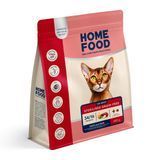
Dry food HOME FOOD for neutered/spayed adult cats Rabbit and Cranberry For sterilised/neutered, 1.6 kg
Buy
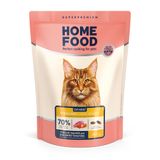
Dry food HOME FOOD for picky neutered/spayed adult cats Chicken & Liver For sterilised/neutered Gourmet, 1.6 kg
Buy
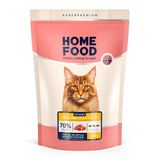
Dry food HOME FOOD for neutered/spayed adult cats with sensitive digestion Lamb and Salmon With sensitive digestion. For sterilised/neutered, 1.6 kg
Buy
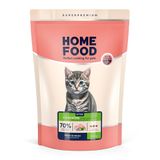
Dry food HOME FOOD for kittens Fresh Chicken For kittens 1-12 months, 1.6 kg
Buy
When it is worth refraining from grains in the diet
There are categories of cats for which grain components are not needed at all:
- Cats with diabetes or metabolic disorders — excess starch can cause fluctuations in blood glucose.
- Cats with allergies or food intolerance to grains.
- Show or breeding cats, where a high concentration of animal protein and low starch content are important.
In such cases, manufacturers offer grain-free (grain-free) foods, where energy is provided by potatoes, sweet potatoes, or other easily digestible carbohydrates.

Grain-free hypoallergenic dry food HOME FOOD for adult neutered/spayed cats Duck and Pear Grain-free hypoallergenic. Suitable for exotic breeds, 1.6 kg
Buy
Grain-free hypoallergenic dry food HOME FOOD for adult neutered/spayed cats Duck and Pear Grain-free hypoallergenic. Suitable for exotic breeds, 400 g
Buy
Conclusion: the evolution of cat food reflects a combination of economics and science. Corn and wheat reduced the cost of feed, but modern high-quality grains such as rice, oats, and buckwheat better meet the physiological needs of cats, providing a balance of energy, digestion, and health without unnecessary allergens.