
Determining a kitten’s sex is often important for owners and breeders: it helps with choosing a name, planning the type of surgery, spaying or neutering, or simply satisfying natural curiosity.
Although a veterinarian provides the highest accuracy, it is quite possible to understand the basics yourself. The key is to consider the kitten’s age, act very carefully, and not rely on only one sign.
At What Age Can You Try to Determine a Kitten’s Sex?
In newborn kittens, determining sex is difficult even for an experienced person. The genital organs are very small, and the fur, even though sparse, can interfere with examination.
- 3 weeks — the minimum age when you can try to determine sex yourself, although the chance of error is still high.
- 1–2 months — the differences become more obvious, and the testes in males may already be felt.
- 3 months — the testes often become visually noticeable.
- 6 months and older — sex is easier to determine not only by physical signs, but also by behavior, because puberty begins.
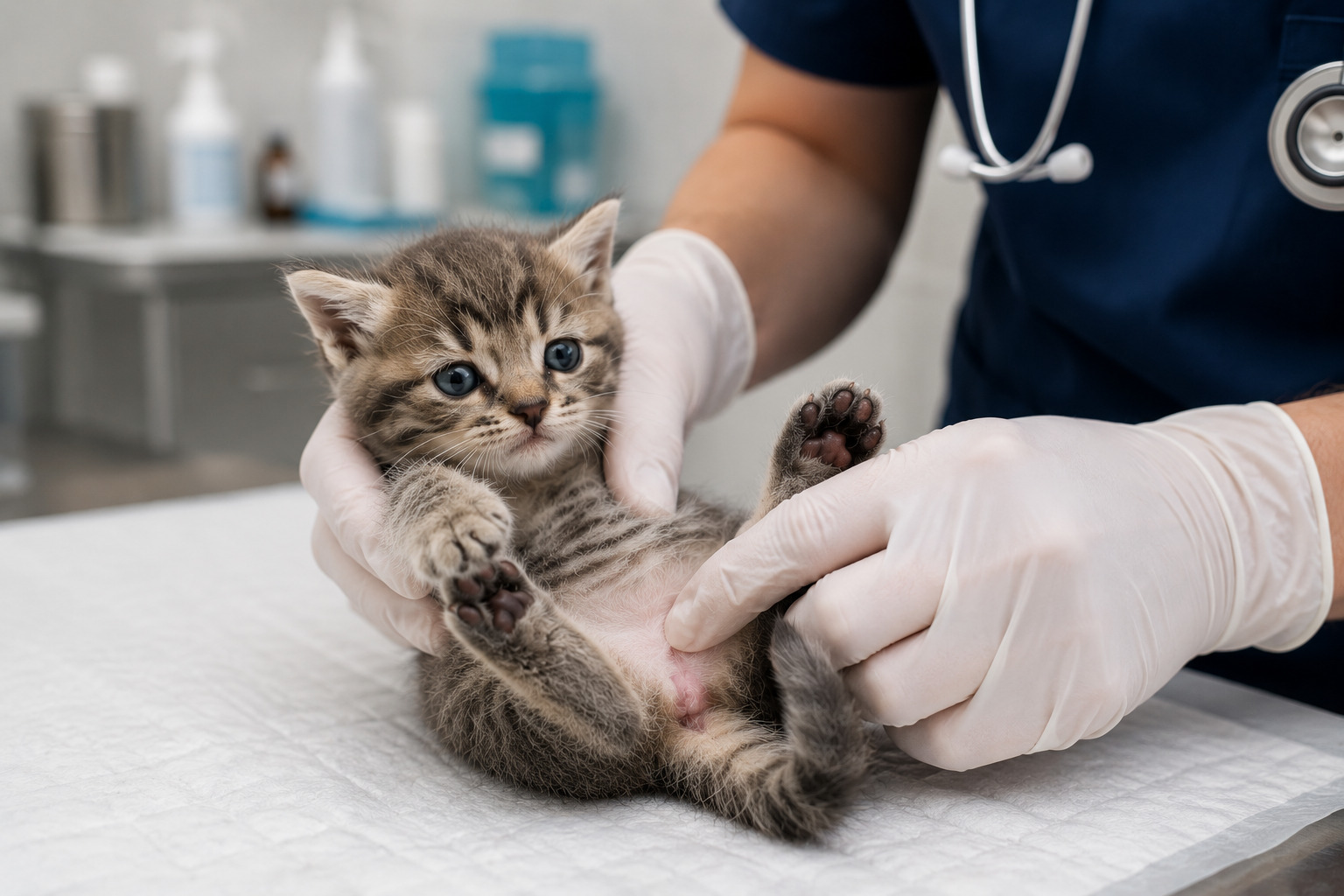

It is best to determine a kitten’s sex when the kitten is calm, has eaten, is awake, and is not nervous
Why Determine Sex as Early as Possible?
Early sex determination is important not only out of curiosity. It helps the owner plan care better and avoid confusion in the future.
- Choosing a name. It is better to choose a name that matches the kitten’s sex right away, because cats quickly get used to their names, and renaming them in adulthood is undesirable.
- Planning care. Knowing the sex helps plan specific care and behavior correction in advance, such as preventing territory marking in male cats.
- Selling and choosing a pet. If you sell kittens or want to adopt an animal of a specific sex, accurate information helps avoid surprises.
Safety Rules: How to Handle a Kitten
Attempts to determine sex can be traumatic for the baby if handled carelessly. A kitten is very small, so all movements should be calm, gentle, and minimal.
- Never pull or tug a kitten by the tail, and never lift it by the tail.
- Do not press on the belly or genital organs.
- If the kitten struggles, cries, or is clearly nervous, stop immediately and postpone the attempt.
- If the mother cat is worried, calm her first and do not take the kitten away for long.
- Do not keep the kitten away from the mother for long: very young animals cannot regulate body temperature well and can get cold quickly.
Hold the kitten gently, place it on its belly, and carefully lift the tail. The fewer manipulations there are, the calmer the examination will be for the kitten.
Ways to Determine a Kitten’s Sex
There are several methods that help determine sex with high accuracy. It is best not to rely on just one sign, but to assess the situation as a whole.
Visual Examination of the Genitals
This is the most reliable method. Place the kitten on its belly, stroke near the base of the tail so it lifts it, and carefully examine the perineal area.
- In female kittens the genitals look like a vertical slit, the distance from the anus to the opening is very short, less than 1 cm, and the area has very little fur.
- In male kittens the genital opening is round or oval, and the distance to the anus is greater, about 1–2 cm, because the scrotum is located between them.
It is easiest to compare several kittens of the same age.
Palpation
Gently move your finger from the anal opening to the genital opening. If you feel a small thickening, these may be the testes, meaning the kitten is male. If nothing can be felt, it is likely female.
This method is more accurate at 2–3 months of age and requires a very gentle touch.
Genetic Analysis
This is the most reliable method. A swab is taken from the inside of the cheek. In addition to precise sex determination, the test may reveal genetic predisposition to serious inherited diseases.

Behavior, coat color, and body build can be clues, but they do not replace a careful examination or a veterinarian consultation
Behavioral and Physical Differences
These signs are less reliable and should only be used as additions to the main methods. They are based on breeders’ experience and do not provide a full guarantee.
- Coat color. A tricolor or tortoiseshell kitten is almost always female, while a fully ginger kitten is quite likely to be male.
- Body build and appearance. As they grow, female kittens are usually smaller with softer features, while male kittens are larger and more massive.
- Behavior. Female kittens are often considered more self-sufficient and independent, while male kittens are often more sociable and people-oriented, but the personality of each animal can vary greatly.
- Urine smell. In males, especially closer to puberty, urine may have a sharper smell than in females.
If the kitten turns out to be male, it is worth preparing in advance for home hygiene and products that remove odors and marks.


Lucky Pet — pet odor and stain remover spray, 250 ml
Buy
Urine Off Cat & Kitten — urine odor and stain remover for cats and kittens, 500 ml
Buy
ProVET SOFTVET — spray repellent for places not intended as a cat toilet, 250 ml
Buy
Doctor Vet — enhanced enzyme odor and stain remover, 500 ml
Buy
Summary
Determining a kitten’s sex is not too difficult if you know the different methods. You can choose one of them, but it is better to approach the question comprehensively: consider age, external signs, behavioral clues, and the kitten’s overall condition.
The most reliable option remains a visit to the veterinarian: the doctor will not make a mistake, and the kitten will receive a safe, calm examination.