📌 HOME FOOD Blog: Does a Cat Need a Collar? Between Care and Risks.
Does a Cat Need a Collar? Between Care and Risks.
Already around 3000 BCE in Mesopotamia (the territory of modern Iraq), dogs were fitted with simple collars made of leather or woven materials — to control their behavior and keep them close to their owner. Over time, these devices became more refined, especially for animals in wealthy families.
In Ancient Egypt, where dogs and cats were revered and associated with gods, scholars discovered brass collars adorned with lotus motifs, hunting scenes, and even a dog's name — as in the case of the dog Tantanuit, whose collar was found in the tomb of the aristocrat Maigepri.
Thus, the collar had not only a practical purpose but also a symbolic one — sometimes even spiritual. It served as a means of identification, a status marker, and protection. Since then, technology and style have evolved, but the core function — helping humans care for their loyal friend — has remained to this day.
A collar on a cat is an item that sparks conflicting opinions. For some, it’s a symbol of responsible ownership, a sign that the animal belongs to a home, a means of identification, or protection against parasites. For others, it’s an unnecessary accessory, and sometimes even a potential danger to the animal’s life.
It might seem like a simple thing — a strip of fabric or leather with a clasp. But behind it lies a series of important questions: Does the collar bother the cat? What risks are associated with wearing it? What types of collars exist, and in what cases are they truly justified?
This material will help you look at the collar not as a fashionable accessory, but as a tool that can both help and harm, depending on the circumstances. We will explore the anatomical and physiological characteristics of cats, their behavior, modern collar types, veterinary recommendations, and potential risks. And most importantly, we will answer the question: Does your cat really need a collar — and if so, which one?
What Types of Collars Are There for Cats: Functions, Materials, and Features
The pet supplies market offers a wide variety of cat collars, each with its own purpose. Choosing the right type depends not only on appearance but primarily on its functional purpose, the animal’s living conditions, and its health status. Let’s examine the main types of collars and their features.
1. Identification Collars
These collars are designed to clearly indicate that the animal has a home and an owner. They most often feature a tag, medallion, or special pocket with contact information.
- Advantages: In case of a runaway or loss, identification helps quickly return the cat home.
- Risks: In outdoor conditions, the collar can get caught on branches or fences, causing injury. Therefore, it’s important to choose models with a "safety" (breakaway) clasp that unfastens under tension.

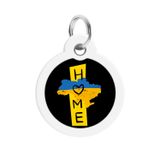
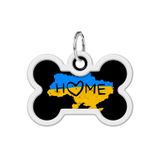
ID Tag for Dogs and Cats in Bone Shape Prapor WAUDOG Smart ID with QR Passport
Buy
Round ID Tag for Dogs and Cats Prapor WAUDOG Smart ID with QR Passport, 30 mm
Buy
WAUDOG Nylon Collar for Dogs with QR Passport, "NASA21" Design, Metal Fastex Buckle, Size S
Buy
Waterproof WAUDOG Collar for Dogs with QR Passport, Reflective, Metal Fastex Buckle, S, W 15 mm, L 25-35 cm, Orange
Buy
2. Anti-Parasite (Insectoacaricidal) Collars
These collars contain active ingredients that repel or eliminate parasites — fleas, ticks, and lice.
- Advantages: Convenient to use, with a long-lasting effect (from 1 to 8 months depending on the brand). Risks: Possible allergic reactions, especially in sensitive animals or with improper product selection. Not recommended for kittens under 2-3 months or cats with chronic conditions.
- Important: Always choose certified products specifically designed for cats (dog versions may contain substances toxic to cats, such as permethrin).

Vitomax - ECO Collar Against Fleas and Ticks for Kittens, 25 cm
Buy
ProVET Insectostop — Anti-Parasite Collar Insectostop for Dogs and Cats, 35 cm
Buy
AnimAll VetLine Wicker — Anti-Parasite Collar AnimAll "White Pearl" for Dogs and Cats, 35 cm
Buy
AnimAll VetLine — Anti-Parasite Purple Collar AnimAll for Dogs and Cats, 35 cm
Buy
3. Decorative (Aesthetic) Collars
Collars that primarily serve for beauty — with bows, rhinestones, fabric elements, bells, etc. They are chosen to highlight the animal’s individuality or create a “festive” look.
- Advantages: Add aesthetics, suitable for photoshoots or social cats participating in exhibitions.
- Risks: May be uncomfortable, cause stress or irritation, and bells can annoy hearing, disrupt sleep, and interfere with hunting (even play hunting).
- Important: A decorative collar must have a safety clasp (breakaway) — one that unfastens automatically if the cat gets caught. This is critically important to prevent choking or neck injury.
- Recommendations: Choose lightweight, soft, removable models without sharp elements. Ideally, the collar should be removable immediately after a photoshoot or walk.
4. GPS Collars and Trackers
Modern technology allows tracking an animal’s location in real-time using a GPS tracker embedded in the collar.
- Advantages: Particularly useful for cats that roam outdoors or have a tendency to run away. Some models offer additional features — activity monitoring, body temperature, even vibration as a signal.
- Disadvantages: Heavier than standard collars, not always comfortable for small or elderly animals. Require periodic charging.
- Price: Higher than average, but justified for active or free-roaming cats.
5. Medical Collars
Have a specific purpose — for example, post-operative protective collars or collars with aromatherapy (calming essential oils).
- Protective collars (Elizabethan): Protect the surgical site or wound from licking.
- Aromatic or pheromone: Contain synthetic pheromones (e.g., Feliway) that reduce stress, especially during relocation, vet visits, or adaptation to a new home.
What should be considered when choosing any collar?
- Weight and size: The collar should be lightweight and not hinder movement. A finger should fit between the cat’s neck and the collar — not too tight, but not too loose.
- Material: Soft, hypoallergenic, and non-irritating to the skin. Avoid rough nylon or cheap leather.
- Clasp mechanism: Best is a breakaway or a clasp with a safety lock that unfastens under strong tension.
- Adaptation: Not all cats accept a collar immediately. Time for adjustment is needed, with gradual introduction.

Who Really Needs a Collar, and Who Doesn’t?
Not every cat needs a collar — and that’s not negligence, but an individual approach.
- Indoor cats that don’t leave the apartment almost have no need for a collar, especially if they are microchipped. Here, a collar might serve only a decorative function (and even then, only with a safety clasp).
- Cats that walk on a leash or have access to a yard need an identification collar with a tag or GPS.
- Semi-outdoor cats that return home to sleep are the most vulnerable. For them, an identification or GPS collar with a breakaway clasp is not a luxury, but protection.
- Kittens, elderly, or sick cats often struggle to adapt to a collar, especially if it’s heavy or irritating. In such cases — either no collar or a very soft, maximally lightweight option.
Advantages and Risks of Wearing a Collar: From a Veterinarian’s Perspective
Advantages:
- Easy return of a lost animal.
- Protection against parasites (if insectoacaricidal models are used).
- Visible sign that the cat has a home (reduces the risk of being taken as a stray).
Risks:
- Neck injuries if there’s no breakaway clasp.
- Allergic reactions to the material or active ingredient (in anti-parasite collars).
- Chronic stress — especially in anxious animals.
The American Veterinary Medical Association (AVMA) recommends: “A collar should be functional, comfortable, and safe, but in no case should it replace a microchip.”
How to Choose the Right Collar: Step-by-Step Guide
- Measure the cat’s neck circumference — add 1-2 cm to this figure.
- Determine the purpose: Protection from parasites? Identification? Just for beauty?
- Material: Choose soft textile or silicone that doesn’t irritate.
- Clasp: Only breakaway! It saves lives.
- Weight: The lighter, the better. The animal should forget it’s there.
- First 10 minutes after putting it on — under supervision. And don’t leave anything unchecked on the cat.
How to Get a Cat Used to a Collar?
Cats don’t like sudden changes — so adaptation should be gentle:
- Let the cat sniff the collar before putting it on.
- Start with 2-3 minutes of wear, gradually increasing the time.
- Use treats after each attempt — cats quickly associate the collar with something pleasant.
- If the cat falls on its side or “plays dead” — it’s not a tragedy, but a defensive reaction. Don’t laugh (though it’s cute), just give it time.
Collar vs. Microchip: What’s More Reliable?
- A collar is visible and instantly conveys the message: “This cat is not a stray.”
- A microchip is invisible but indispensable when a collar is lost. It contains a number registered in a database and works for a lifetime.
The ideal combination: microchip + identification collar. One for reliability, the other for speed.
Real Stories: When a Collar Saves or Harms
- “Marquis” got lost on New Year’s Eve but returned home because he had a tag with his owner’s phone number.
- Cat Lea got caught on a dresser handle with her collar. Thankfully, the breakaway clasp unfastened instantly.
- An elderly cat developed dermatitis from a cheap rough nylon collar — treatment took three weeks.
Moral: Every detail matters. Safe material, the right clasp, and the owner’s attentiveness — that’s true protection.
A collar for a cat is not just an accessory. It’s a tool that can provide additional protection, a means of communication with others, or a source of discomfort if chosen incorrectly. In a world where cats are accustomed to going their own way, it’s up to us, humans, to ensure their safety.
The choice should always be justified: taking into account the animal’s lifestyle, physiology, age, character, and your real needs. And if a collar becomes part of your shared routine — let it be lightweight, safe, and comfortable, just like your care itself.
Because in the end, the best collar is the love that’s visible to the naked eye.