The manul, or Pallas's cat, seems like an almost fairy-tale animal: a round face, very thick fur, short legs and a stern gaze, which is why it is often called the 'grumpiest cat in the world'. But behind this appearance lies not a domestic breed, but a rare wild predator that has adapted perfectly to life in the cold steppes and rocky landscapes of Central Asia.
Pallas's cat cannot be tamed and is not suitable for living next to humans in an apartment or private house. That is why it is important to talk about it not as an 'exotic pet', but as a species that requires protection, respect for wildlife and responsible treatment from people.
In this article, we will look at where the Pallas's cat lives, how it hunts, why it is considered one of the most elusive wild cats, what threats it faces and why attempting to keep it at home is both illegal and dangerous for the animal itself.
Brief species description
| Scientific name | Otocolobus manul |
| Other name | Pallas's cat |
| Type | Wild predator from the Felidae family |
| Size | Medium; body length usually 46–65 cm, tail 21–31 cm |
| Weight | Approximately 2.5–5 kg, seasonally may appear more massive due to very thick fur |
| Lifespan | In the wild, often around 8 years; in controlled conditions, it can live longer |
| Coloration | Gray, silvery-gray or yellowish-sandy, with good camouflage in nature |
| Fur type | Very thick, long, dense; one of the densest among wild cats |
| Character | Solitary, elusive, territorial, cautious around humans |
| Habitat | Steppes, semi-deserts, rocky plains and foothills of Central and Eastern Asia |
| Conservation status | On the IUCN Red List, the species is assessed as Near Threatened, meaning it is close to threatened status |
| Keeping at home | No; this is a wild species that is not suitable for domestic life and requires protection of its natural habitat |
Origin and history of the species
Pallas's cat has nothing to do with domestic breeding: it is a separate wild cat species that evolved in the harsh natural conditions of Central Asia. Its Latin name Otocolobus manul is associated with unusually low-set ears, and the name 'Pallas's cat' recalls the German naturalist Peter Simon Pallas, who described this species in the 18th century.
Specialists from the Cat Specialist Group and conservation organizations consider Pallas's cat one of the least studied wild cats in Eurasia. It survived sharp climate changes, adapted to life on open cold plains and retained a hunting method that is almost independent of fast prey pursuit.
Today, Pallas's cat remains a symbol of wild steppe nature. Its study is important not only for zoology, but also for understanding the state of the entire ecosystem, where shelters are disappearing, food sources are declining and human pressure is increasing.
- Pallas's cat is a separate wild species, not a breed of domestic cat.
- The species was described by Peter Simon Pallas in the 18th century, hence the name 'Pallas's cat'.
- The main modern range covers Central and partly Eastern Asia.
Appearance and anatomical features
Pallas's cat often seems much larger than it actually is. This effect is created by incredibly thick fur, which helps it withstand severe cold, wind and snow. In size, it is closer to an ordinary domestic cat, but visually appears more massive, lower and denser.
Pallas's cat has a wide and somewhat flattened head, large eyes, round pupils, and low-set ears on the sides of the head. This is exactly what helps it remain inconspicuous in the terrain when the animal watches for prey from behind stones or grass.
Pallas's cat has a long, very fluffy and striped tail. It not only helps maintain balance, but also serves a practical role in the cold: while resting, the cat can cover its body and paws with it. The coloration of the fur changes depending on the season, which further camouflages the animal in the steppe or on rocky slopes.
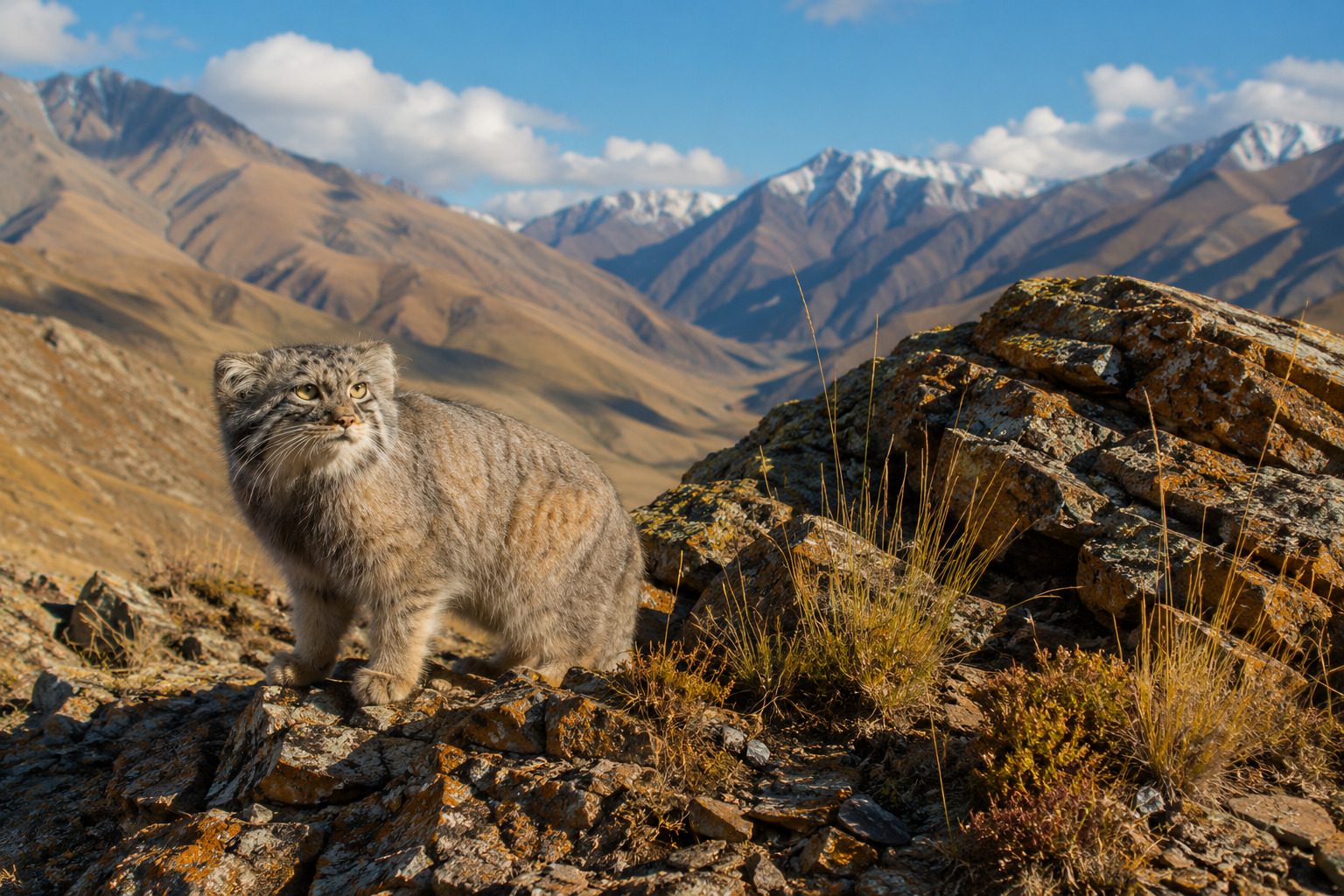

Pallas's cat is easy to recognize by its very thick fur, wide face and low-set ears
Character and behavior
Pallas's cat is a loner. It leads a predominantly solitary lifestyle, occupies its own territory and does not seek contact with either humans or other animals. In nature, this gives it an advantage: secrecy and peace reduce the risk of conflicts and help conserve energy.
Outwardly, Pallas's cat may seem unhurried, but in danger it behaves decisively: it hisses, growls, tries to hide or defends itself. This is not a 'wild cat with a soft heart for home', but a full-fledged predator with its own boundaries and clear defensive behavior.
Pallas's cat is characterized by caution, waiting and minimizing unnecessary movement. It does not like fuss and cannot tolerate constant attempts at contact. This is the main reason why Pallas's cat cannot be tamed like domestic cats.
Habitat and ecology of the species
Pallas's cat lives in regions with a dry climate, vast spaces and natural shelters. It is found in Mongolia, China, Kazakhstan, Kyrgyzstan, parts of Russia, Iran and other regions of Central Asia. The species tends toward steppes, semi-deserts, rocky slopes and high-altitude plateaus.
The most important factor for Pallas's cat is access to shelter. It uses burrows of other animals, crevices between stones, depressions in slopes or caves. These shelters allow it to wait out daytime activity and sudden weather changes.
- Pallas's cat avoids dense forests and places without natural shelters.
- The most typical biotopes for it are cold steppes, rocky plains and dry slopes.
- Low population density makes the species vulnerable even to local environmental changes.
Feeding and hunting
Pallas's cat is an ambush predator. It does not rely on long pursuits like larger cats, but chooses a tactic of patient waiting. When prey approaches a sufficient distance, the animal makes a short and precise strike.
In nature, the diet of the Pallas's cat consists mainly of small mammals, particularly rodents and pikas. The Pallas's cat may also hunt small birds, and more rarely lizards or other small animals. Importantly, this species plays a beneficial role in steppe ecosystems by regulating the population of small rodents.
Due to its short legs, the Pallas's cat is not a sprinter, so hunting success depends on precise calculation, camouflage, and knowledge of the territory. For this reason, landscape destruction and the reduction of shelter sites are particularly damaging to this species.
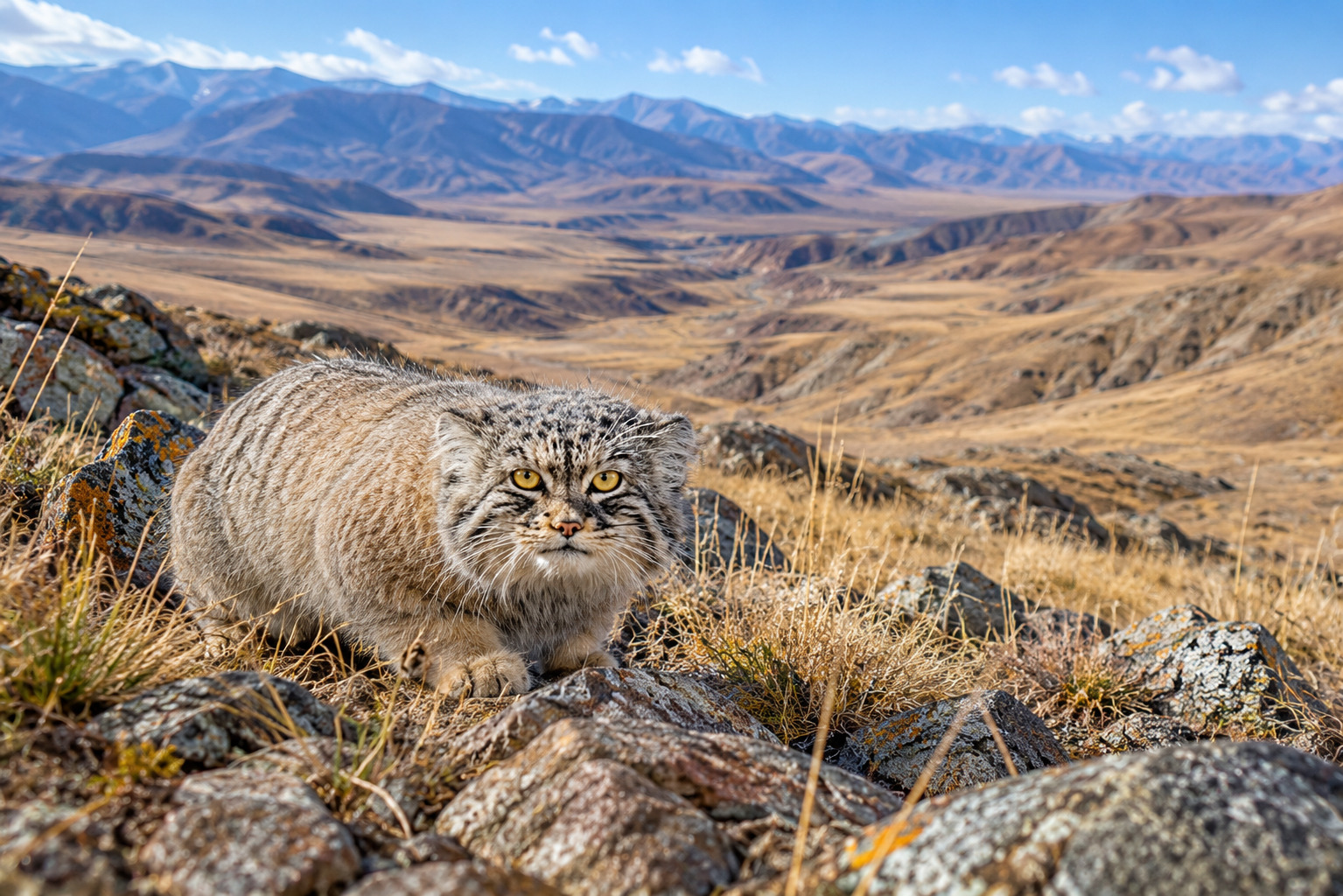
The Pallas's cat does not pursue prey for long, but hunts from ambush, relying on camouflage and patience
Why the Pallas's cat needs protection
According to the IUCN Cat Specialist Group, the Pallas's cat belongs to species that are already in a vulnerable position: it is classified as Near Threatened. This means that without proper protection, populations may continue to decline due to habitat change and direct or indirect human impact.
Among the main threats are the degradation of steppe ecosystems, the reduction of prey availability, poisoning of the food base during rodent control, accidental trapping, and disturbance in habitats. For such a secretive and locally distributed species, even minor disruptions to ecological balance have serious consequences.
Protecting the Pallas's cat requires not only protected territories, but also control over the use of poisons, preservation of shelter sites, monitoring of populations, and education of local communities. The Pallas's cat is a good indicator of how healthy the steppe ecosystem remains overall.
- The Pallas's cat suffers from habitat loss and the reduction of its food base.
- Rodent poisoning affects not only the prey, but also the predator itself through secondary poisoning.
- Protecting the Pallas's cat is simultaneously protecting the steppes, semi-deserts, and the natural balance of these territories.
Can you keep a Pallas's cat at home?
The short answer is no. The Pallas's cat is not a domestic cat breed, has not undergone domestication, and is not adapted to life in an apartment or private house. For it, natural shelter, a large territory, natural prey, low stress levels, and conditions that cannot be recreated in the everyday life of an ordinary owner are critically important.
A separate issue is the physiology and behavior of a wild animal. Pallas's cats have difficulty coping with stress, respond poorly to forced contact, and can seriously injure a person in self-defense. Additionally, in many countries, their private keeping is prohibited or strictly limited by law.
The most correct approach to the Pallas's cat is to admire it as a wild species, support nature conservation initiatives, and not create demand for the illegal removal of such animals from the wild.
What your domestic cat really needs instead of exotic alternatives
If you like wild feline aesthetics, that is not a reason to seek a rare predator for your home. It is much more correct to create good conditions for an ordinary domestic cat: provide it with a complete diet, clean water, protection from parasites, and a safe environment without access to dangerous hunting.
This approach shows real respect for animals: wild species remain in nature, and domestic ones receive proper care and quality everyday life alongside humans.
Conclusion
The Pallas's cat is one of the most distinctive and secretive wild cats of Asia. Its thick fur, calm stern gaze, and ability to survive in extreme conditions are truly impressive, but for this very reason, it should remain where it belongs—in its natural habitat.
The best thing a person can do for the Pallas's cat is not to seek to own it, but to support the protection of wild ecosystems and treat domestic animals responsibly. Loving cats does not mean taming everything wild; sometimes it means stopping in time and letting nature remain nature.