How can you tell that a food suits your dog or cat? Good appetite, shiny coat, an active pet — wonderful. But there is one more indicator that owners see practically every day — stable, well-formed stools.
We humans hardly count every day how many grams of fiber we get from vegetables, fruits or grains. More often, we simply go by how we feel: comfortable or heavy after a meal, whether we feel full, how our gut is working.
Our furry friends have less choice. It is pet parents who decide what goes into the bowl today, so the responsibility for a balanced diet lies with us. If the diet doesn’t quite meet the animal’s needs, the first signals may include constipation, overly soft stools, gas, rumbling or bloating.
And then a natural question arises: what exactly in the food helps the gut work steadily?
One of the answers is fiber and prebiotic components. Let’s look at why dogs and cats need them, how fiber differs from prebiotics, and why the “crude fiber” figure on a pet food package tells far from the whole story.
What is fiber and why do animals need it?
Let’s start with an interesting fact: fiber is also a carbohydrate. But it behaves in the digestive tract quite differently from sugars or starch.
In a simplified classification, carbohydrates are divided into simple and complex. Simple carbohydrates primarily include various sugars. Complex ones include starch and a large group of dietary fibers that we usually call fiber.
But fiber itself is not uniform either. This name covers a whole group of substances with different properties. That is why, in international practice, dietary fibers are characterized not only as soluble or insoluble. Their viscosity is also taken into account, as well as how actively they can be fermented by the gut microbiota.
This is where it becomes clear why even a cat — a natural predator — needs fiber. It is not meant to replace animal protein or become the foundation of the cat’s diet. Its task is different: to help the gut work normally, contribute to stool formation and create favorable conditions for the gut microbiota.
Soluble and insoluble fiber: what’s the difference
The easiest way to picture fiber is as two big teams, each doing its own job.
| Property | Soluble fiber | Insoluble fiber |
|---|---|---|
| Interaction with water | Swells or dissolves; some fibers form a viscous mass | Practically insoluble |
| Main job | Water retention, microbiota support | Bulk of intestinal contents, motility |
| Fermentation | Many types are actively used by bacteria | Usually less fermentable |
| Examples | inulin, pectins, psyllium | cellulose, some hemicelluloses |
Insoluble fiber gives intestinal contents structure and bulk and helps them move normally through the digestive tract.
Soluble fiber interacts more with water. Some of these fibers become a nutrient resource for the bacteria of the large intestine. In other words, its role goes far beyond simply forming stools.

That is why a good formula is not about adding as much of one type of fiber as possible, but about combining fibers with different properties
Where fiber in pet food comes from
If you look at a food’s ingredient list, the word “fiber” may not appear at the top at all. Its sources are various plant ingredients, and each of them has its own characteristics.
Cellulose mainly provides the structural, insoluble part of fiber and supports the normal movement of intestinal contents.
Beet pulp is interesting because it contains different fiber fractions — both structural ones and those available for fermentation by the microbiota.
Psyllium works actively with water: it swells and helps regulate the consistency of intestinal contents.
Inulin is a different story. It is a fermentable component with prebiotic properties that is used by the gut microbiota.
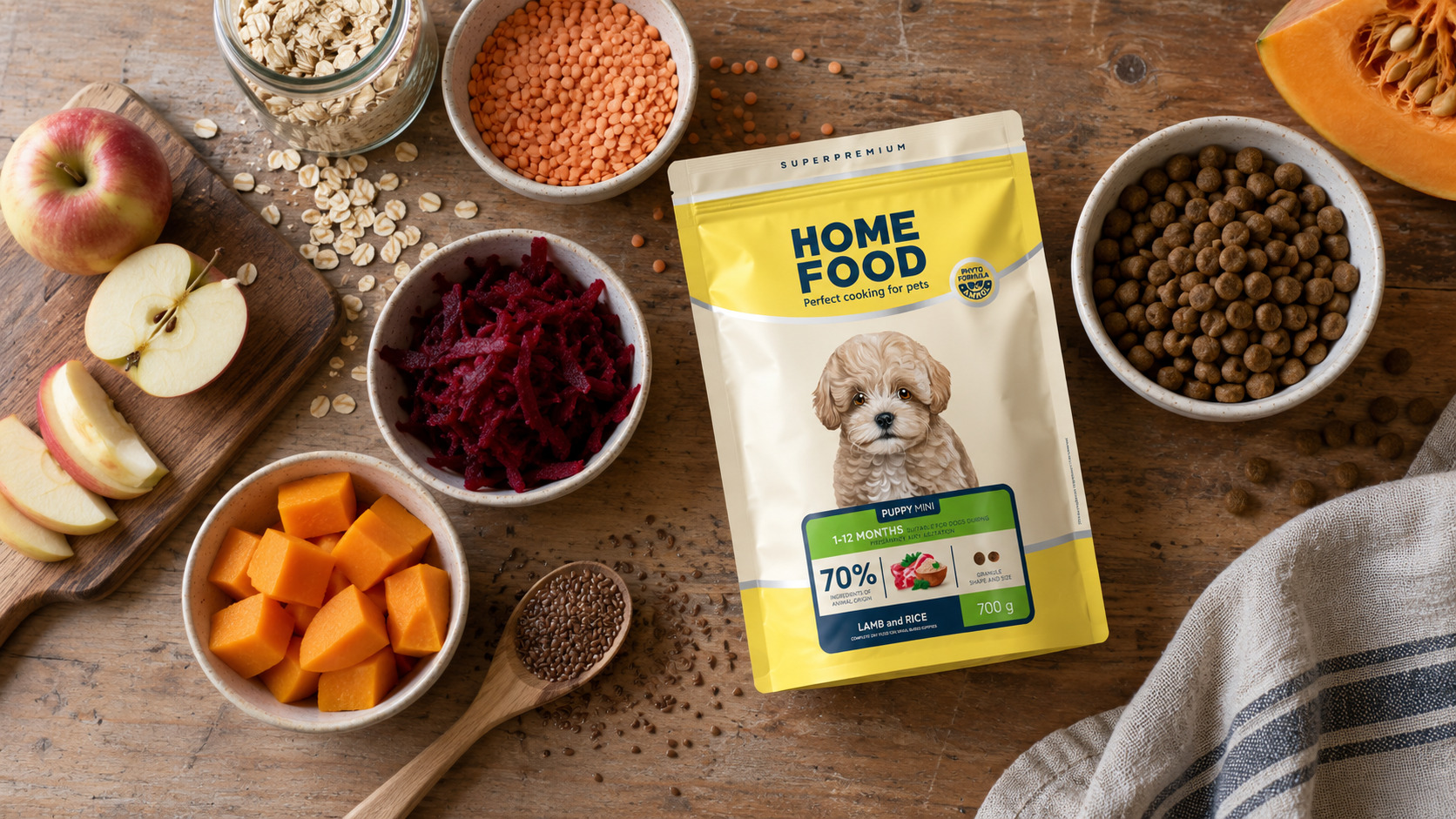
Apple, pumpkin, lentils, amaranth, flax, chia and other plant ingredients also add their own set of dietary fibers to the diet.
That is why two packages with the same nominal “4% fiber” can work in completely different ways. The percentage matters, but what matters just as much is exactly which components it is made up of.
What are prebiotics in pet food
This is where confusion often arises: fiber, prebiotics, probiotics — it all seems to be “for the gut”, so it must be the same thing? Actually, no.
Prebiotics are interesting because part of their work happens not directly through the dog’s or cat’s body, but through the microorganisms that inhabit the gut.
Certain prebiotic components become a nutrient substrate for beneficial microbiota. Bacteria use it in their own metabolism and produce various substances, including short-chain fatty acids. These, in turn, are involved in maintaining a normal environment in the gut and the condition of its mucous membrane.
So prebiotics are not just “something for constipation”. Their job is much broader.
Pet foods may contain several functional components:
- inulin — a well-known prebiotic substrate for the gut microbiota;
- FOS, or fructooligosaccharides — fermentable oligosaccharides used by beneficial bacteria;
- MOS, or mannan oligosaccharides — functional components often derived from yeast cell walls;
- β-glucans — polysaccharides whose action depends on their structure and source;
- psyllium — primarily a functional dietary fiber that retains water well and helps normalize intestinal contents.
And here is an important rule: not all fiber is a prebiotic, and not all components that support the gut work the same way.
Prebiotics and probiotics: who “feeds” whom?
The easiest way to remember this difference takes literally one sentence.
Probiotics are live beneficial microorganisms, while prebiotics are components that certain members of the gut microbiota can feed on.
That is why it makes perfect sense to see both prebiotic substrates and probiotic cultures in the same diet.
When they are combined so that they functionally complement each other, this is referred to as a synbiotic approach.

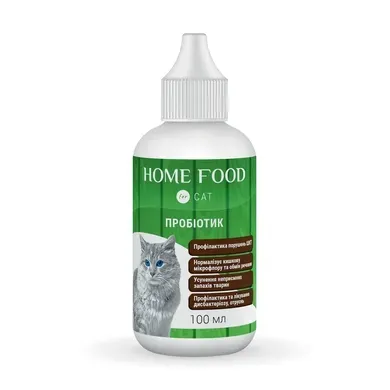


That is why a modern pet food may contain not a single “magic ingredient for digestion”, but a whole complex of substances with different mechanisms of action
The gut microbiome: a whole ecosystem inside
The gut of a dog or cat is home to a huge number of microorganisms. They don’t just passively live alongside the animal — there is a constant exchange between them and the body.
The microbiota is involved in processing some dietary components, producing metabolites and interacting with the intestinal mucosa and local immune mechanisms.
That is why today people increasingly talk not only about “normal digestion”, but about a healthy gut microbiome.
And prebiotics in pet food are one way to support a favorable nutrient environment for it.
Why are stools a marker of how the food is working?
Now let’s return to what an owner can see without tests or a laboratory.
If stools are well-formed, moderate in volume, with no regular diarrhea, constipation, large amounts of mucus or excessive gas — that’s a good sign that the gut is doing its job.
This is where the work of fiber is especially noticeable.
When certain fibers are lacking, motility may suffer. If the ratio of different fiber types is off, stools can become too dry or, conversely, soft. And a large amount of fermentable substrate in sensitive animals is sometimes accompanied by more active gas production.
So a good ingredient list on the package is only the beginning. The final verdict always comes from the body of the particular dog or cat.

Stools can be called the digestive system’s daily report
How much fiber should be in pet food?
It’s tempting to want a simple number: 2%, 3%, 5% — and case closed.
But fiber doesn’t work that way.
Its level can vary noticeably from one complete food to another. It is influenced by the animal’s species and age, the diet’s calorie content, the set of ingredients and the functional purpose of the food itself.
Let’s look at some specific HOME FOOD examples.
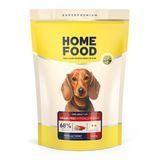
The grain-free food for adult medium and large breed dogs “Duck and chickpeas” contains 3.6% crude fiber.
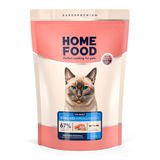
In the diet for active cats “Chicken and shrimp”, it is 3.7%.
In the food for neutered cats “Rabbit and cranberry”, it is 4.4%.
And in the HOME FOOD “Turkey and berries” Hairball Control diet for cats, this figure reaches 5.8%.
Why more? Because the task is different too.
Cats regularly swallow hair, and some of it has to pass through the digestive tract naturally. That is why Hairball Control uses an extended complex of dietary fibers: red lentil fiber, beet pulp, whole oats, psyllium, as well as β-glucans, MOS and inulin.
So the question “how much fiber should be in pet food?” has a follow-up: “what job exactly should this fiber do?”

HOME FOOD grain-free hypoallergenic dry food for adult medium- and large-breed dogs “Duck and chickpeas”, 10 kg
Buy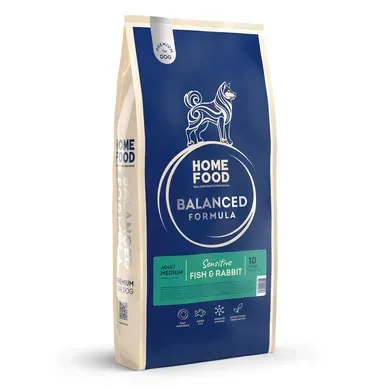
HOME FOOD dry food for adult medium-breed dogs with sensitive digestion “Fish and rabbit”, 10 kg
Buy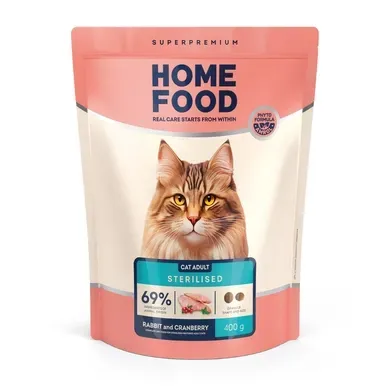
HOME FOOD dry food for sterilised/neutered adult cats “Rabbit and cranberry”, 400 g
Buy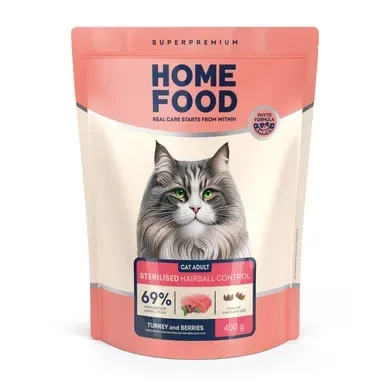
HOME FOOD hairball control dry food for sterilised/neutered adult cats “Turkey and berries”, 400 g
Buy
FOS, MOS and prebiotic complexes in pet food
Among the best-known prebiotic components in pet foods, FOS and MOS are often mentioned.
FOS — fructooligosaccharides — are actively used by certain gut bacteria as a nutrient substrate.
MOS — mannan oligosaccharides — work differently. They help maintain a favorable intestinal environment and interact with certain undesirable bacteria, reducing their ability to attach to the mucosa.
Modern HOME FOOD formulas use another interesting principle: MOS is combined with various prebiotic components, types of fiber and plant fiber sources.
For example, the food for small breed puppies “Lamb and rice” contains 2.2% crude fiber. The formula combines MOS, β-glucans, chicory inulin, psyllium, apple and the AMROL phyto-formula, and they are joined by the probiotic Saccharomyces boulardii. In other words, different types of dietary fiber and components that support the gut microbiota are working here at the same time.
In the food for picky neutered cats Chicken & Liver, crude fiber is already at 4.4%. Here, MOS, β-glucans and inulin are complemented by psyllium, red lentil fiber, apple, pumpkin and a plant-based phyto-formula.
Two diets, two different fiber figures — but one formulation logic: no single component has to do everything; instead, different fiber sources should complement each other.

HOME FOOD dry food for small-breed puppies “Lamb and rice”, 700 g
Buy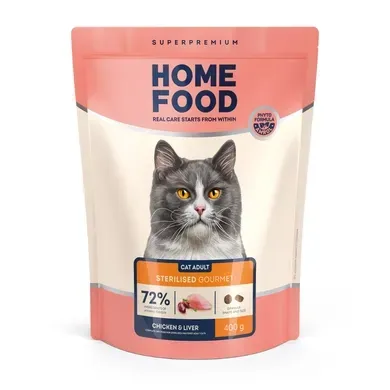
HOME FOOD dry food for picky sterilised/neutered adult cats Chicken & Liver, 400 g
Buy
Frequently asked questions
Why do cats need fiber if they are predators?
A cat remains a true predator, and fiber should not displace animal-based nutrients from its diet. But in a small, functional amount, dietary fibers help support gut function, stool consistency and the microbiota. And in hairball diets, they also help swallowed hair pass through naturally.
How much fiber should be in pet food?
There is no single right number for all dogs and cats. What matters is not only the percentages, but also the fiber sources, their properties and the purpose of the diet. FEDIAF also does not set a separate universal fiber requirement for dogs or cats. Its amount in a complete food is chosen taking into account the animal’s species and age, the energy value of the diet, the type of fiber and its functional purpose. That is why the “crude fiber” figure should always be assessed together with the food’s composition.
How do prebiotics differ from probiotics?
Probiotics are live beneficial microorganisms. Prebiotics are dietary components that certain members of the gut microbiota can use for their growth and activity.
What are FOS and MOS in pet food?
FOS and MOS are functional oligosaccharides used in diets to support the intestinal environment. FOS mainly serve as a fermentable substrate for beneficial microbiota, while MOS have a different mechanism of action and can interact with certain undesirable bacteria.
Key points about fiber
Fiber is by no means a “food filler”, and not just a means of achieving normal stools.
Soluble and insoluble fibers, inulin, psyllium, MOS, β-glucans and plant ingredients each do different work, but the most interesting part begins precisely when they are skillfully combined in one diet.
So when reading a food’s ingredient list, pay attention not only to the “crude fiber” line. Look a little deeper: where the dietary fibers come from, whether there are prebiotic components, and which animal the diet was created for.
This is how the numbers on the package turn into a clear nutritional logic — stable digestion, gut comfort and everyday well-being for your furry friend.